Summary:
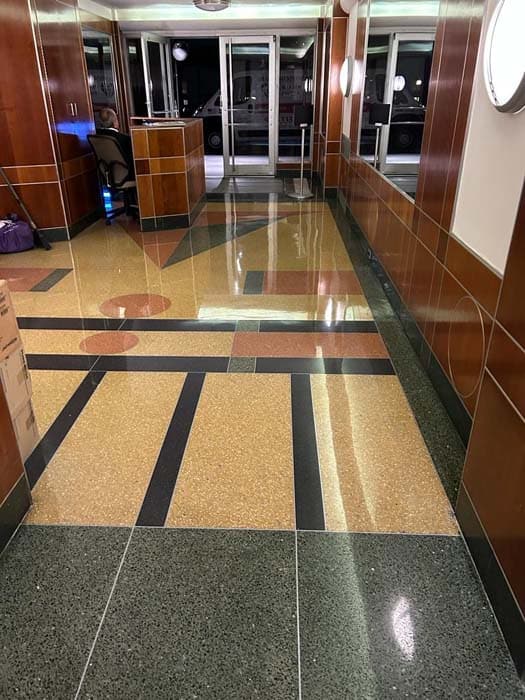
New York County has more original terrazzo floors than almost anywhere else in the country. Pre-war lobbies on the Upper West Side, co-op hallways on Park Avenue, apartment bathrooms in buildings that have been standing since the 1920s — the material is everywhere. And most of it is still in remarkable shape, considering its age. The problem isn’t usually the terrazzo itself. It’s what happens to it over decades of well-meaning but mismatched maintenance.
If you’re managing or owning a pre-war building in New York County and wondering why your floors look dull, scratched, or just wrong despite regular cleaning, the answer is almost always in how the floor has been treated — not how old it is.
What Makes Pre-War Terrazzo Floor Cleaning Different
Original cement terrazzo and modern flooring are not the same material, and they don’t respond the same way to cleaning. The terrazzo installed in New York County buildings between roughly 1900 and 1939 was made using a cement binder mixed with marble chips — sometimes glass, sometimes granite — and finished by hand. It’s dense, it’s durable, and under the right conditions it can last well over 75 years.
But that cement binder is also chemically sensitive in ways that a lot of cleaning crews simply don’t know about. The standard all-purpose cleaners used in most commercial cleaning programs — anything acidic, anything with bleach, anything marketed as a heavy-duty degreaser — can eat into that cement matrix over time. Vinegar is one of the worst offenders, and it’s commonly recommended online as a “natural” floor cleaner. On terrazzo, repeated exposure to acidic products causes the surface to pit and dull in ways that look like wear but are actually chemical damage.
By the time it’s visible, the harm is already done.
Why Your Building's Cleaning Crew May Be the Problem
This is the part nobody wants to hear, but it’s one of the most common scenarios we encounter in New York County buildings: the terrazzo floor has been maintained consistently for years, and it still looks terrible. The lobby gets mopped every day. The super is on top of it. And yet the floor is dull, scratched, and seems to get worse every season.
In most of these cases, the issue isn’t a lack of effort — it’s that the wrong products have been used for years, or even decades. General cleaning crews are trained to clean, not to identify flooring materials and match their products accordingly. They use what works on tile, what works on vinyl, what works on concrete. On original cement terrazzo, those products cause cumulative damage that compounds quietly until one day the floor looks genuinely bad and nobody can explain why.
The damage shows up as dull patches that won’t respond to mopping, a surface that feels slightly rough or uneven, and sometimes a chalky or hazy appearance that no amount of cleaning seems to fix. What’s actually happening is that the cement binder is being slowly broken down, and the aggregate — the marble chips that give terrazzo its character — is losing the surface layer that made it reflective and smooth.
There’s also the wax problem. For decades, building maintenance programs included regular wax application on terrazzo floors. Wax was the standard. The issue is that wax builds up in layers over time, yellows, traps dirt, and eventually creates a surface that looks perpetually grimy no matter how recently it was cleaned.
Stripping old wax buildup is often the first step in any serious terrazzo restoration, and the layers we find in pre-war New York County buildings can represent 30 or 40 years of accumulation. Professional terrazzo floor cleaning — real cleaning, not just mopping — involves stripping those wax layers, removing embedded grit and staining, and assessing what the actual surface condition is underneath. Only then can you know what the floor actually needs.
The Carpet-Over-Terrazzo Discovery: What to Do When You Find Original Floors
One of the most common calls we get from Manhattan property owners and building managers goes something like this: they’re renovating an apartment or updating a lobby, they pull up the carpet, and underneath they find original terrazzo. It’s exciting — original material, irreplaceable craftsmanship — and immediately alarming, because the floor underneath looks like it’s been through a war.
Carpet tack holes around the perimeter. Adhesive residue from the carpet backing. Scratches from decades of grit trapped between the carpet and the floor. Sometimes staining from moisture that got trapped underneath. The floor is intact, but it doesn’t look like it.
This is actually one of the most restorable scenarios there is, and it happens constantly in pre-war New York County buildings. The terrazzo was protected by the carpet in some ways — it wasn’t exposed to cleaning products, foot traffic, or waxing cycles — so the underlying material is often in better structural shape than floors that have been “maintained” for decades. The surface damage looks dramatic, but it’s largely cosmetic.
The restoration process for a carpet-removal discovery typically involves removing adhesive residue with appropriate solvents, filling tack holes with a tinted filler matched to the existing aggregate, then grinding, honing, and polishing the surface back to a finish. The tack hole fills, when done correctly, are nearly invisible — the filler is color-matched to the specific marble aggregate in the floor, so the repairs blend into the surrounding material.
What the floor looks like at the end of that process often surprises people. Original pre-war terrazzo, properly restored, has a depth and character that modern flooring simply cannot replicate. The marble aggregate catches light differently. The surface has a solidity to it. And the knowledge that it was installed by Italian craftsmen a hundred years ago, and is now going to last another hundred, tends to make the restoration feel like exactly the right decision.
How Professional Terrazzo Floor Polish Actually Works
Polishing terrazzo is not the same as buffing a floor. A lot of people assume the process involves applying a product to the surface — a polish, a wax, a coating of some kind — and that the shine comes from the product. It doesn’t.
Professional terrazzo polishing is a mechanical process that works by removing the damaged surface layer of the stone itself, using progressively finer diamond abrasives until the material underneath is smooth and reflective enough to hold a finish. The difference matters because a product-based shine sits on top of the floor and wears off. A mechanically polished surface is the floor — it’s the actual terrazzo, refined to a mirror-like smoothness, and it holds up under foot traffic in a way that wax or coating never can.
The Step-by-Step Terrazzo Floor Repair and Polishing Process
The process starts with a thorough assessment of the floor’s condition — what kind of terrazzo it is, what the binder composition looks like, what coatings or wax layers are present, and what specific damage needs to be addressed before polishing can begin. Pre-war cement terrazzo and modern epoxy terrazzo respond differently to diamond abrasives and polishing compounds, so identifying what you’re working with isn’t optional. It’s the foundation of everything that follows.
After assessment and any necessary wax stripping or deep cleaning, crack and chip repair comes next. Cracks and chips in terrazzo aren’t just cosmetic — they can allow moisture into the cement matrix, which causes the damage to spread. The repair process involves filling cracks and holes with a tinted material matched to the existing aggregate blend, then allowing it to cure before grinding. Done well, the repairs are essentially invisible once the floor is polished.
The grinding and honing phase is where the real work happens. Diamond abrasive pads — starting coarser and working progressively finer — remove the damaged surface layer of the terrazzo, leveling out scratches, removing staining that has penetrated the surface, and creating a uniformly smooth base for polishing. This step requires industrial-grade equipment. Consumer-grade buffers and floor machines don’t have the weight or the abrasive consistency to do this correctly, and attempting it without the right equipment can leave the floor uneven or cause heat damage to the surface.
Once the floor is honed to the right level of smoothness, the polishing phase brings the finish up — matte, satin, or high-gloss, depending on the preference and the building’s aesthetic. The final step is applying an impregnating sealer, which penetrates the pores of the terrazzo and inhibits staining without sitting on top of the surface as a coating. This is what allows the floor to be maintained with simple sweeping and neutral-pH mopping, without ever returning to a wax program.
How Long Does Terrazzo Floor Repair and Polishing Last in a High-Traffic New York County Building?
This is one of the most common questions we hear from building managers and co-op boards, and it’s a fair one. New York County lobbies are not low-traffic environments. A 200-unit pre-war building can see hundreds of passes through the lobby every day, and winter brings in salt, grit, and moisture from the sidewalk that acts as an abrasive on any floor surface.
A professionally diamond-polished terrazzo floor, properly sealed, holds up for eight to ten years under normal use in a high-traffic environment — and that’s a conservative estimate for New York County conditions. Compare that to a wax maintenance program, which requires stripping and reapplication every few months and still never produces the same quality of finish. The math is straightforward, and the disruption calculus is even more lopsided: a full restoration is a one-time project, while a wax program is a recurring operational burden.
After the initial restoration, maintaining the finish doesn’t require another full grinding and honing cycle. Periodic professional polishing with finer grits is enough to refresh the surface and extend the life of the finish. The heavy work — the grinding, the crack repair, the wax stripping — is behind you.
It’s also worth noting that restoration costs significantly less than replacement. In New York County, where labor costs, building logistics, and material access all add to the price of any construction project, the savings of restoring an existing floor versus tearing it out and installing new material are substantial. And unlike replacement, restoration preserves the original material — the irreplaceable, hand-crafted cement terrazzo that defines the character of a pre-war building and cannot be reproduced at any price.
For buildings in NYC landmark districts or historic designations, that preservation argument isn’t just aesthetic. The NYC Landmarks Preservation Commission has specific expectations around maintaining original architectural features in designated buildings, and terrazzo floors in landmarked pre-war buildings are exactly the kind of element that falls under that umbrella.
Finding the Right Terrazzo Polishing Specialist in New York County
Original pre-war terrazzo is one of New York County’s most underappreciated architectural assets. It’s durable, it’s beautiful, and when it’s properly cared for, it outlasts nearly every other flooring material available. But it does need the right care — not general floor maintenance, not the same products used on tile or vinyl, and not a contractor who treats every floor the same way regardless of what it’s made of.
The floors in your building have already survived a hundred years. With the right approach, they’ll look better than they have in decades and keep performing for decades more. If you’re dealing with dull surfaces, wax buildup, carpet-removal damage, or floors that have been cleaned with the wrong products, most of it is recoverable — you just need someone who actually knows what they’re working with.
We work with pre-war terrazzo throughout New York County, and a free estimate is the easiest way to find out exactly what your floor needs.