Summary:
You’ve probably looked at a tarnished brass elevator door or a scratched-up stainless steel panel and assumed the only fix was a full replacement. That’s the same assumption a lot of New York County building managers make — right up until they see what professional metal refinishing can actually do.
Most worn metal surfaces aren’t ruined. They’re just overdue for the right process. Whether you’re managing a pre-war co-op on the Upper West Side or a Class A office tower in Midtown, the condition of your lobby metals sends a message to everyone who walks through the door. The good news is you don’t have to spend a fortune to change that message.
What Metal Refinishing Actually Does — and What It Doesn't
Metal refinishing is the process of restoring a metal surface to its original appearance — or close to it — without removing and replacing the material itself. That covers a wide range of problems: scratches, oxidation, tarnishing, dulling, and general wear that builds up over years of daily contact.
What it doesn’t cover is structural damage. If a panel is severely corroded all the way through, or a railing has significant physical deformation, that’s a different conversation. But for the vast majority of architectural metalwork we see in New York County — elevator cab interiors, lobby doors, handrails, signage frames, and decorative fixtures — the damage is surface-level, and refinishing is a completely viable solution.
The mistake most people make is assuming that visible damage means permanent damage. It usually doesn’t.
How the Metal Refinishing Process Works, Step by Step
The process starts with a thorough assessment of the surface — the type of metal, the extent of the damage, and the original finish. This step matters more than most people realize. Brass, stainless steel, bronze, copper, and aluminum each respond differently to refinishing techniques, and applying the wrong approach to the wrong metal can make things worse, not better.
A proper assessment tells you exactly what you’re working with before anyone picks up a tool. Once the assessment is done, the surface is cleaned and prepped. This means removing dirt, oils, oxidation, and any existing coatings that have degraded.
If the metal was previously lacquered — which is common on brass fixtures in older New York County buildings — that lacquer often needs to be stripped before the underlying metal can be properly addressed. This step is unglamorous but essential; skipping it is one of the main reasons DIY attempts and cut-rate services don’t hold up.
From there, the actual refinishing work begins. Depending on the metal and the finish, this can involve polishing, buffing, grain-matching on stainless steel, or applying a new protective coating. Finish matching is where the skill really shows. A good technician can replicate the original grain direction and sheen so precisely that the restored area is indistinguishable from the surrounding surface. We’ve seen this level of precision on everything from mirrored elevator panels to brushed satin handrails in commercial lobbies.
The final step is applying a protective coating or sealant to extend the life of the refinished surface and slow down future oxidation and wear. Done correctly, a professional refinish isn’t a temporary cosmetic fix — it’s a durable result that can last for years with routine maintenance. The difference between a refinish that holds and one that fades in six months almost always comes down to what happens in this final step.
Natural Stone Restoration and Metal Refinishing: Why New York County Lobbies Need Both
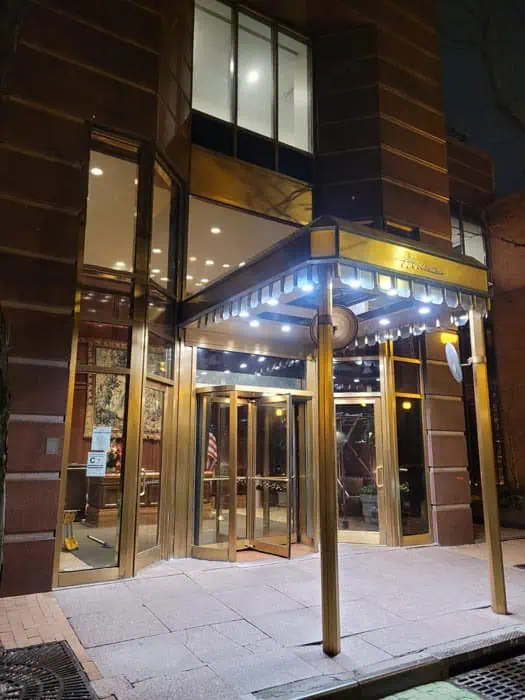
Here’s something most building managers in New York County don’t think about until they’re already sourcing two separate contractors: a typical lobby almost never has just one surface type. You’ve got marble floors, a stone reception counter, and then brass elevator doors, stainless steel handrails, and bronze fixtures — all in the same space, all showing wear at the same time.
Most restoration companies make you split that work across multiple vendors. One company handles the natural stone restoration, another handles the metal. That means two separate estimates, two separate schedules, two different crews navigating your building, and double the coordination headache. In a New York County building — where parking is limited, freight elevator windows are narrow, and residents notice everything — that kind of logistics problem isn’t trivial.
We handle both. Stone and metal restoration aren’t separate specialties for us; they’re part of the same service. When we assess a lobby, we’re looking at the full picture — the terrazzo floor, the granite threshold, the marble walls, and the brass elevator doors — and we put together a plan that addresses everything in one coordinated visit. That’s not a small thing when you’re managing a building with a board to answer to and residents who expect minimal disruption.
This combined capability also means the results are visually cohesive. When the stone and the metal are restored by the same team, with the same eye for finish and detail, the lobby looks like a unified space — not like different sections were touched up by different crews at different times. In high-end New York County buildings, that kind of consistency matters.
Commercial Restoration Services in New York County: What Building Managers Should Know
New York County’s building stock is unlike anywhere else. Pre-war co-ops, landmarked commercial towers, boutique hotels, and Class A office buildings all share one thing: original architectural metalwork that’s irreplaceable by modern fabrication standards. When a 1930s lobby has original brass elevator doors, you can’t just order new ones. Restoration is often the only path that preserves what’s actually there.
Beyond historic buildings, the sheer volume of daily use in New York County accelerates wear on every metal surface in a building. A 30-story residential building with hundreds of residents and daily deliveries will show elevator wear in months. That’s not a maintenance failure — it’s just the reality of the environment. Commercial restoration services need to be built around that reality, not around suburban timelines.
How Long Does Metal Refinishing Take in a New York County Building?
This is the question building managers in New York County ask us most often — and understandably so. Taking an elevator out of service in a Manhattan high-rise isn’t like closing a room for repairs. It affects every resident, every delivery, every service call.
Downtime has real consequences. The honest answer is that most elevator cab metal refinishing can be completed in a single day. A standard passenger elevator cab — panels, doors, threshold — can typically be refinished and returned to service within an eight-hour window. That means work can begin after the last evening rush and be finished before the morning, with no disruption to residents during the day.
It’s one of the clearest practical advantages refinishing has over replacement, which can take days or weeks depending on fabrication and installation timelines. For larger projects — a full lobby with multiple metal surfaces, or a building with several elevator cabs — the timeline extends, but the work is still staged to minimize disruption.
We schedule around freight elevator windows, building access restrictions, and board-approved work hours. New York County buildings have specific rules about when contractors can work and how they access the building, and we’ve been navigating those constraints long enough to know how to plan around them. One of our clients noted that their technician proactively sent a message about a five-minute delay due to parking — a small thing that made a real impression. In a city where contractor reliability is a legitimate concern, that kind of communication is how we operate.
Refinishing vs. Replacement: How to Know Which One You Actually Need
The most common trigger for a metal refinishing inquiry is a replacement quote that feels disproportionate to the problem. A building manager sees scratched stainless steel elevator panels, gets a quote for full replacement, and the number is significant enough to make them wonder whether there’s another option. There usually is.
If the damage is surface-level — scratches, oxidation, tarnishing, a dulled finish, or a lacquer that’s peeling — refinishing is almost certainly viable. If the metal has corroded through, has significant structural deformation, or has been compromised in a way that affects its function, replacement may be necessary. But that second category is far less common than most people assume when they’re looking at a worn surface.
One thing we do that separates a real assessment from a sales call is honest diagnosis. We’ve had situations where clients came to us after two other companies quoted full repairs or full replacement — and when we looked at the actual surface, the damage was minor enough to start addressing during the estimate visit. That’s just what happens when someone looks at the surface with the right experience and without a financial incentive to overstate the problem.
Refinishing also costs a fraction of replacement in most cases. The exact figure depends on the surface area, the type of metal, and the extent of the damage — but the gap between restoration and replacement is consistently significant, especially in New York County where labor and material costs are among the highest in the country. If you’ve received a replacement quote and you’re not sure it’s necessary, getting a refinishing assessment first is a straightforward way to find out.
For buildings in landmarked districts — and New York County has more than 120 historic districts overseen by the NYC Landmarks Preservation Commission — restoration of original materials isn’t just cost-effective. In some contexts, it’s the preferred or required approach. Replacing original architectural metalwork in a landmarked building can involve LPC review and approval. Restoring it usually doesn’t.
Is Metal Refinishing the Right Call for Your New York County Building?
If your building has metal surfaces that look worn, tarnished, or scratched — and you haven’t had a professional assess whether they can be restored — that’s the logical first step. Most of the time, the answer is yes, and the cost difference compared to replacement is significant enough to make the conversation worthwhile.
New York County buildings have specific demands: tight schedules, board oversight, high resident expectations, and architectural details that can’t always be replicated if they’re removed. Metal refinishing, done right, addresses all of that without the disruption or expense of replacement.
Diamond Stone Restorations Corp works with residential and commercial clients across New York County, handling both metal refinishing and natural stone restoration from a single point of contact. If you want an honest assessment of what’s possible for your building’s surfaces, reach out to schedule a free estimate — we’ll tell you exactly what we’re looking at and what it would take to fix it.