Summary:
If your granite floors look dull, scratched, or just not the way they used to, you’re probably wondering whether it’s worth doing something about it before the cold arrives. The honest answer is yes — and timing matters more than most people realize.
New York County winters are uniquely hard on stone surfaces. Salt, grit, freeze-thaw cycles, and heavy foot traffic don’t pause between October and April. What they do is stack up, season after season, on surfaces that were never sealed or haven’t been touched in years. The fall window — roughly August through October — is when granite floor restoration makes the most practical sense. Here’s why, and what the process actually looks like.
What New York County Winters Actually Do to Granite Floors
Most people think granite is indestructible. It’s not. It’s durable, yes — but it’s also porous, and it reacts to what it’s exposed to. In New York County, that exposure includes road salt from November through March, mineral deposits from hard water, and the kind of foot traffic that would qualify as commercial-grade even in a residential building lobby.
Salt is the biggest issue. When it’s tracked in from salted sidewalks throughout the county, it doesn’t just sit on the surface — it starts etching it. Over multiple winters, unprotected granite loses its finish, develops a dull haze, and in some cases begins losing silica, which creates small holes or craters that require diamond grinding to correct. That’s a more involved and more expensive fix than what a properly timed restoration would have cost in the first place.
Why Pre-War Manhattan Buildings Face a Steeper Challenge
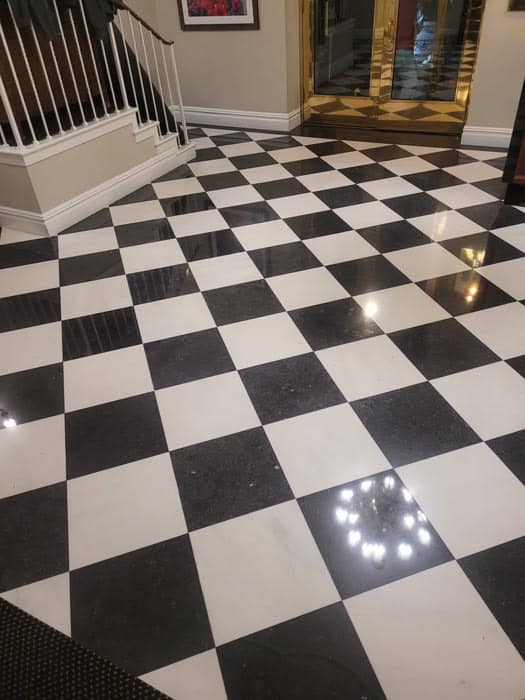
A significant portion of New York County’s residential building stock was built between 1900 and the 1940s. These pre-war buildings — the kind you find throughout the Upper West Side, Washington Heights, and across the borough — often have original granite or marble floors in their lobbies, hallways, and entryways. Some of those floors are 80 to 100 years old.
That’s a long time to absorb salt seasons, hard water deposits, and the weight of constant foot traffic. The stone itself is often still structurally sound — granite doesn’t just give out — but the surface can look worn, stained, or permanently dull if it hasn’t been professionally restored in years.
Here’s what’s worth understanding: most of that damage is fixable. The assumption that old, beaten-up granite needs to be replaced is one of the most common and costly misconceptions we run into. A lobby floor that looks like it belongs in a demolition site can, in many cases, be brought back to something close to its original condition through professional granite restoration — without tearing anything out, without weeks of construction, and without the disruption that comes with a full renovation.
For co-op and condo boards managing common areas in New York County, this matters a lot. Replacement means board approvals, contractor bids, resident notifications, and weeks of disruption to shared spaces. Restoration means our crew comes in, does the work, and leaves the floor looking dramatically better — often within a single day. The cost difference is significant too. Professional restoration runs a fraction of what full replacement costs, and for a lobby floor that sees daily use, that’s a meaningful budget consideration.
The freeze-thaw cycle adds another layer of complexity for New York County buildings. Any stone near exterior doors — lobby entryways, vestibules, ground-floor hallways — is exposed to temperature swings that stress grout lines and stone edges over time. Cracks, chips, and uneven tile heights (called lippage) are common in older buildings, and they’re the kind of issues that get worse each winter if they’re not addressed.
Stone Countertop Restoration: Worth Doing at the Same Time
If you’re already scheduling granite floor restoration, it’s worth asking about your countertops at the same time. Stone countertop restoration follows a similar process — cleaning, surface repair, refinishing, and sealing — and having both done in a single visit is more efficient and less disruptive than scheduling two separate appointments.
In New York County kitchens especially, granite and stone countertops take a beating. Hard water leaves mineral deposits. Acidic foods and cleaning products etch the surface. Over time, what was once a polished, reflective countertop starts to look cloudy or scratched. The fix isn’t replacement — it’s restoration. Color-matched repair compounds handle chips and cracks, diamond abrasive techniques remove surface damage, and professional-grade sealing protects the result.
The reason this matters in the context of fall scheduling is simple: if you’re already coordinating access to your unit or building for floor work, adding countertop restoration to the same visit costs less in time and coordination than two separate appointments. For property managers handling multiple units, this kind of bundling is especially practical.
We work on granite, marble, quartz, and other natural stone surfaces — floors and countertops alike. If you’re not sure whether your countertops are restorable, a free estimate will tell you quickly. Most surface damage that looks permanent isn’t. What looks like a stain, a scratch, or a dull patch is usually something that responds well to the right professional approach.
One thing customers often mention after the fact is that they wish they’d done it sooner. Not because the process is complicated, but because the result is better than they expected — and the cost of waiting turned out to be higher than the cost of acting. That’s especially true for granite surfaces heading into another New York County winter without a protective seal.
What Granite Floor Restoration Actually Involves
The process isn’t mysterious, but it’s also not something consumer products can replicate. Professional granite floor restoration starts with an assessment of the stone’s condition — what kind of damage is present, how deep it goes, and what approach will produce the best result for that specific surface.
From there, the work follows a consistent sequence: diamond abrasive grinding and polishing to remove the damaged surface layer, chip and crack repair using color-matched compounds, refinishing to the desired finish level, and professional-grade sealing to protect the result. That last step — sealing — is what determines how long the restoration holds up against whatever comes next.

How Long Does Granite Floor Restoration Take?
For most residential projects — a kitchen floor, an entryway, a bathroom — restoration is typically completed in a single visit. You’re not looking at days of disruption. Our crew comes in, does the work, and the space is usable again once the sealer has cured.
Commercial projects scale with the size of the space. A lobby floor in a mid-size New York County building takes longer than a studio apartment kitchen, but the process is the same. We’ve completed multi-story commercial projects — floors and stone surfaces across six stories of a building — efficiently enough that clients specifically mentioned the speed as something that stood out.
For building managers and supers coordinating around tenant schedules, that matters. The goal is always to minimize disruption to residents and building operations. Work can be scheduled around building access windows, and we’re flexible about timing to make that happen.
One detail worth knowing: the sealer needs time to cure properly after application. Temperature and humidity affect curing conditions, which is one of the reasons fall is a better scheduling window than mid-winter. By October, summer humidity has passed, temperatures are stable, and the sealer can cure under better conditions than it would in January.
We apply two coats of professional-grade sealant — not one. It’s a small detail that makes a real difference in how well the surface holds up over time, especially in high-traffic environments. Customers who’ve done their research often ask about this specifically, and it’s something we’re consistent about regardless of project size.
How Do You Know If Your Granite Needs Restoration or Replacement?
This is the question most people are actually asking when they call. The surface looks bad — maybe really bad — and they don’t know whether they’re looking at a restoration job or a full replacement. The honest answer is that the vast majority of granite floor damage falls into the restorable category.
Scratches, etching, dullness, staining, minor chips, and even some cracks are all conditions that professional granite restoration addresses. The surface damage that looks permanent — the kind that makes you assume the stone is ruined — is usually a surface-layer issue that diamond abrasive techniques can remove, revealing undamaged stone beneath.
Replacement becomes the right answer in specific circumstances: structural failure, severe lippage that can’t be corrected by grinding, or stone that’s been damaged beyond the restorable layer. These situations exist, but they’re less common than people assume. What we find more often is that someone was told by a non-specialist that their floor needed to be replaced, when in fact it needed restoration.
For New York County homeowners and property managers, the cost difference is worth understanding. Professional granite restoration costs a fraction of what full replacement runs — and that gap widens considerably when you factor in the construction disruption, board approval timelines for co-op buildings, and the logistical complexity of replacing stone in a high-rise apartment. If there’s any uncertainty about which path makes sense for your floor, a free estimate is the fastest way to get a clear answer.
We’ve worked on granite floors in New York County buildings that hadn’t been professionally touched in decades. The results in those cases are often dramatic — not because we’re doing anything extraordinary, but because the stone itself was never actually damaged beyond repair. It just needed the right process applied by someone who knows what they’re doing with natural stone.
If your building or unit has granite floors that look like they’ve seen better days, don’t assume the worst before getting a professional assessment. The answer might surprise you.
The Right Time to Schedule Granite Floor Restoration in New York County
The fall window is real, and it closes faster than it feels like it will. Once November arrives in New York County, you’re already in the salt season — and any granite floor that isn’t sealed going into winter is absorbing another round of damage.
Scheduling now means your floors are protected before that starts. It means the sealer cures under better conditions. It means your building lobby, your kitchen floor, or your entryway looks the way it should before the holiday season, not after another winter of wear.
If you’ve been thinking about it, this is the practical moment to act. Diamond Stone Restorations Corp offers free estimates with no obligation, transparent pricing, and flexible scheduling around your availability. Reach out and find out what restoration can do for your granite floors before winter makes the job harder than it needs to be.