Summary:
You noticed the crack last week. Or the dull gray surface that no amount of cleaning seems to fix. Or the chunk of aggregate that’s simply gone, leaving a rough void in what used to be a beautiful floor. Now you’re wondering whether you’re looking at a quick fix or a complete overhaul — and whether the floor is even worth saving at all.
Here’s the honest answer: in most cases, it is. Terrazzo is one of the most resilient flooring materials ever installed, and the damage that looks catastrophic to an untrained eye is often very manageable. But not all damage is equal, and understanding what you’re actually dealing with changes everything.
For worn or cracked terrazzo, see our terrazzo floor restoration service.
How to Read Terrazzo Floor Damage Before Calling Anyone
The first thing most people get wrong is treating all terrazzo damage as the same problem. A hairline crack running across a lobby floor and a section of delaminated terrazzo near a building entrance are completely different situations — one is typically a cosmetic fix, the other requires a more involved assessment before any repair work begins.
Before you call a contractor, it helps to know what you’re looking at. Not because you should diagnose it yourself, but because being able to describe the damage accurately leads to a faster, more honest estimate — and protects you from being oversold on work you may not need.
Hairline Cracks, Chips, and Surface Pitting — Usually Repairable
Hairline cracks are probably the most common terrazzo complaint we hear from New York County building managers and homeowners. They’re thin, often barely visible from a standing position, and almost always cosmetic in nature. These cracks typically form over decades as a building settles, expands, and contracts with seasonal temperature changes — something that’s especially common in older Manhattan buildings that have been through eighty or a hundred winters.
The good news is that hairline cracks respond well to professional repair. The process involves cleaning the crack thoroughly, filling it with a color-matched epoxy compound mixed with aggregate chips that mirror the original floor’s stone type, size, and color, then grinding the repaired area flush with the surrounding surface and polishing it back to the original finish. Done properly, the repair blends in. You’re not left with an obvious patch.
Aggregate chips — small sections where the marble or stone chips have come loose from the cement matrix — are handled the same way. The key is matching the original aggregate as closely as possible. This isn’t guesswork; we work from samples taken directly from the floor itself, not from a manufacturer’s catalog. That’s how a repair on a 1940s terrazzo floor in a Midtown co-op building can look like it was never touched.
Surface pitting, where the matrix has worn down unevenly and left a rough or cratered texture, is also firmly in the repairable category. This is often the result of years of improper cleaning products, acidic spills, or — very commonly in older New York County buildings — decades of wax and floor coating buildup that eventually degrades the surface beneath it. Progressive diamond grinding followed by polishing can restore the surface to a smooth, even finish without touching the rest of the floor.
Deep Staining, Delamination, and Structural Cracks — What Changes the Equation
Deep staining is a step up in complexity, but it’s still very often repairable. Stains that have penetrated the cement matrix — from water infiltration, rust, oil, or years of cleaning product residue — may require more aggressive grinding to remove the affected layer before polishing can begin. In a building where a pipe has leaked slowly behind a wall for months, the staining can run deep. But even in those cases, the solution is usually restoration, not replacement.
Delamination is where things get more serious. This happens when the terrazzo topping separates from the substrate beneath it — usually from moisture getting underneath over time. You can often identify it yourself with a simple tap test: knock on the floor with your knuckle or a coin, and listen for a hollow sound. A solid terrazzo floor sounds dense. A hollow sound means the bond has failed in that spot. Delaminated sections can’t simply be polished over — the topping needs to be properly re-bonded or, in more severe cases, removed and reset before any surface restoration makes sense.
Structural cracks are the other scenario that requires a different approach. These aren’t the fine hairline cracks caused by normal building movement — they’re wider, often recurring, and caused by ongoing shifting in the substrate or building structure itself. Filling a structural crack with epoxy without addressing the underlying movement is a temporary fix at best. The crack will return. A proper assessment determines whether the movement has stabilized or whether the substrate needs attention before the surface can be repaired with any lasting result.
That said, even delamination and structural cracking rarely mean full replacement. In our experience working in New York County buildings — from pre-war residential lobbies on the Upper West Side to commercial corridors in Midtown — the scenarios that genuinely require pulling up and replacing the entire floor are uncommon. What they do require is an honest assessment from someone who knows what they’re looking at and isn’t motivated to sell you more than you need.
Terrazzo Restoration vs. Repair: When the Whole Floor Needs Attention
There’s a meaningful difference between repairing isolated damage and restoring an entire floor. Repair targets a specific problem — a crack, a chip, a stained section. Restoration addresses the floor as a whole: grinding down the surface to remove years of wear, scratches, and coating buildup, then polishing back through progressive stages to restore the original finish and sealing to protect it going forward.
Sometimes isolated repair isn’t enough. If your terrazzo floor has damage in multiple areas, has lost its shine uniformly, or has years of wax coating layered on top of the original surface, spot repairs will look inconsistent against the surrounding floor. In those cases, full restoration produces a better result and a more consistent appearance across the entire surface.
Why So Many New York County Terrazzo Floors Need Full Restoration — Not Just Repair
Most terrazzo floors installed in New York County were laid between the 1920s and the 1960s — a period when the material was at its peak popularity for building lobbies, hallways, stairwells, and residential common areas. That means the typical floor you’re dealing with in a New York County, NY co-op or pre-war apartment building is somewhere between sixty and a hundred years old.
At that age, the damage is rarely isolated. It’s accumulated. Decades of foot traffic have worn the surface unevenly. Building staff have applied floor wax year after year, building up layers of coating that yellow over time and obscure the terrazzo’s natural color entirely. Cleaning products that were too acidic have etched the surface. Pipes have leaked. Construction on neighboring properties has sent vibrations through the building. The result is a floor that looks dull, gray, and tired — not because it’s failing, but because it’s been through a lot.
Full restoration addresses all of that at once. The process starts with diamond grinding — using progressively finer abrasive pads to strip away the damaged surface layer, remove coating buildup, and level any uneven areas. From there, the floor moves through polishing stages that bring back the natural luster of the aggregate. Finally, a penetrating sealer is applied to protect the surface and make future maintenance easier.
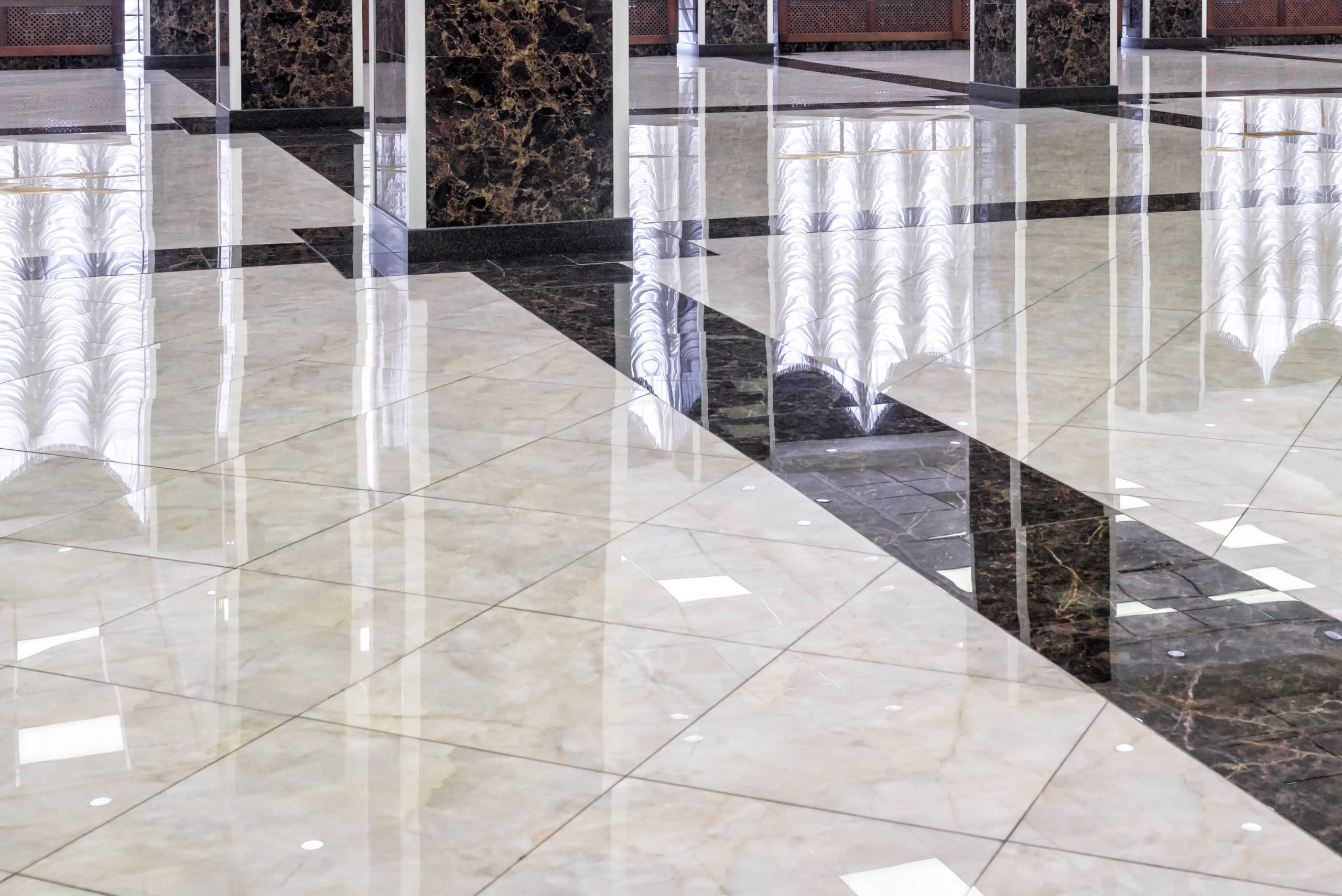
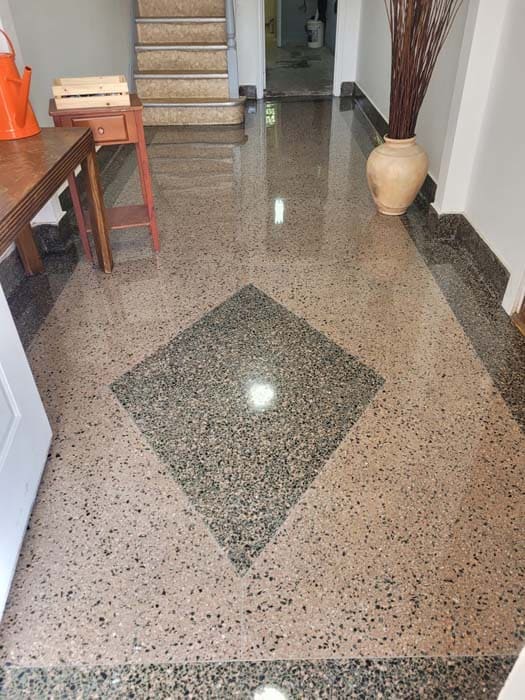
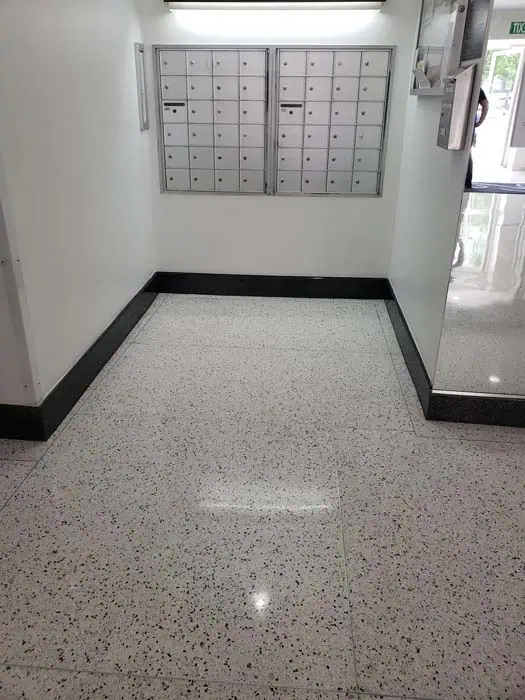
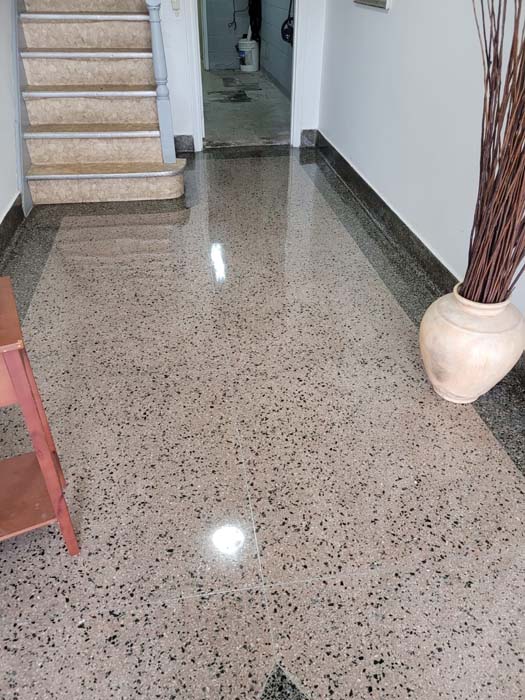
The difference between a restored New York County terrazzo lobby and the same floor before the work is often dramatic. The original colors come back. The aggregate — marble chips, granite chips, or glass, depending on the floor — catches the light the way it was designed to. It stops looking like a tired old floor and starts looking like the architectural feature it always was.
For building managers and co-op boards in New York County, NY, this matters beyond aesthetics. A well-maintained lobby floor signals building quality to prospective tenants and buyers. In a market where New York County real estate values are what they are, the return on a professional restoration is often significant.
Frequently Asked Questions About Terrazzo Floor Repair
**Can terrazzo floors be repaired without replacing them?** In the vast majority of cases, yes. Hairline cracks, surface pitting, aggregate chips, deep staining, and even moderate delamination can all be addressed through professional repair or restoration. Full replacement is genuinely rare and typically only warranted when the substrate beneath the terrazzo has been structurally compromised — which is uncommon even in very old floors.
**How much does terrazzo floor repair cost?** Restoration work — grinding, polishing, and minor repairs — generally runs in the range of $3 to $8 per square foot, depending on the condition of the floor and the scope of work involved. Compare that to full terrazzo replacement, which can cost $20 to $50 per square foot, and the financial case for restoration becomes very clear very quickly.
**How long does a restored terrazzo floor last?** A properly restored floor can go ten to twenty years before needing another full restoration, depending on traffic levels and how well it’s maintained in the interim. Regular maintenance — neutral cleaner, periodic resealing, no wax products — extends that window considerably.
**What causes terrazzo floors in New York County buildings to crack?** Several factors are specific to New York County. Seasonal temperature swings cause the building materials to expand and contract over time. Buildings near subway lines experience ongoing low-level vibration that contributes to hairline cracking over years. Aging plumbing infrastructure means water infiltration is a common culprit in older New York County, NY buildings. And constant construction activity throughout the county — street work, neighboring renovations, infrastructure projects — sends vibration through building structures that can worsen existing cracks or create new ones.
**Can marble countertops be repaired the same way?** Yes, and the process is similar in principle. Chips and cracks in marble countertops can be filled with color-matched epoxy, ground flush, and polished back to a smooth finish. Etching — the dull marks left by acidic liquids like lemon juice or wine — is addressed through honing and polishing. The result, when done correctly, is a countertop that looks repaired in the best possible sense: you can’t tell it ever happened. We handle marble countertop repair alongside terrazzo and stone restoration, so if you’re dealing with both, it’s typically one conversation.
**How do I know if my floor needs repair or full restoration?** The honest answer is that it depends on the extent and distribution of the damage. Isolated damage in otherwise good condition usually calls for targeted repair. Uniform dullness, widespread coating buildup, or damage in multiple areas typically means full restoration will produce a better result. An in-person assessment is the only reliable way to know — and we’ll tell you which one you actually need, not which one costs more.
What to Do Next If Your Terrazzo Floor Needs Repair in New York County
The most important thing you can take away from this is that visible terrazzo damage is almost never as final as it looks. The floor that’s been cracking, dulling, or deteriorating for years in your New York County, NY building lobby or apartment hallway has almost certainly survived worse — and with the right approach, it can be brought back.
What makes the difference is an honest assessment from someone who knows the material, knows the building types common to New York County, and isn’t going to tell you that you need a full restoration when a targeted repair will do the job just as well.
If you’re in New York County and you’re trying to figure out what you’re actually dealing with, we offer free estimates with no pressure and no hidden fees. Reach out, describe what you’re seeing, and we’ll tell you exactly what we think — including if it turns out to be less serious than you feared.