Summary:
Here’s a situation that plays out constantly in New York County apartments and building lobbies: someone notices their marble floor looks dull and scratched, calls around for quotes, hears the word “polishing” from every company, pays for the work — and two months later the floor looks exactly the same as before. Sometimes worse.
The problem usually isn’t the stone. It’s that polishing and refinishing aren’t the same thing, and most companies use these words as if they are. Understanding the difference before you hire anyone can save you real money and a lot of frustration. That’s what this page is for.
What Is Stone Refinishing — and How Is It Different from Polishing?
Polishing is a surface treatment. It adds sheen to stone that’s already in decent shape — smoothing out minor haziness and bringing up the reflective quality of the surface. It works well when the stone itself is fundamentally sound and just needs a refresh.
Refinishing goes deeper. We use diamond abrasive pads to physically remove a thin layer of the stone, taking the damage with it. Scratches, etch marks, and worn patches aren’t buffed over — they’re ground away, and then the surface is rebuilt back up through a progressive polishing sequence. The result lasts because we’ve actually addressed what caused the dullness in the first place.
Full restoration is the most intensive version — multi-stage diamond grinding used when a surface has significant damage, deep scratches, or uneven wear across a large area. Most surfaces fall somewhere between polishing and refinishing, which is why a proper assessment before any work begins matters so much.
Why the Terminology Confusion Leads to Bad Outcomes
The stone care industry has a language problem. Walk through five company websites and you’ll find “polishing,” “refinishing,” and “restoration” used interchangeably — sometimes all three on the same page to describe the same service. For a buyer trying to figure out what their floor actually needs, this is genuinely confusing, and the confusion has real consequences.
When someone hires a polishing-only service for a floor that needs true refinishing, the result looks good for a few weeks and then fades. That’s not because stone restoration doesn’t work — it’s because the wrong process was applied. A topical polish sits on the surface. It doesn’t reach the layer of stone where the etching, scratching, or wear actually lives. So as soon as foot traffic or daily use resumes, the shine disappears.
This is especially common with marble. Marble is a calcium-based stone, which means it reacts chemically with acids — citrus juice, wine, vinegar, and most household cleaners will etch it on contact. Etching isn’t a surface problem. It’s a chemical change in the stone itself, and no amount of polishing will fix it. What you need is refinishing: diamond abrasives that remove the etched layer and restore the actual stone surface underneath.
Not every company asking for your business has the equipment or training to do true refinishing. A wet-dry polisher and some compound is a very different setup from a multi-head diamond grinding system working through five or more progressive grits. Knowing what to ask — and what to look for — before you book anyone is the most practical thing you can do as a buyer.
How to Tell Which Process Your Stone Actually Needs
The condition of your surface is the starting point. If your stone looks hazy but doesn’t have visible scratches or dull patches from etching, polishing may be all it needs. If you can see where the finish has changed — cloudy spots from acidic spills, visible scratches from foot traffic or furniture, or areas that look flat and dead compared to the rest of the surface — that’s refinishing territory.
Run your fingernail lightly across the dull area. If you can feel a slight texture difference or a rough patch where the surface used to be smooth, that’s an etch or a scratch that’s penetrated the stone. Polishing won’t reach it. Refinishing will.
For floors, the wear pattern tells you a lot. High-traffic paths — the route from the front door to the kitchen, the area in front of the elevator — tend to show wear first. If the rest of the floor still looks good and only the traffic lanes are dull, you’re likely looking at refinishing for those sections and a lighter polish for the rest. A technician who actually knows stone will tell you this honestly rather than quoting you for a full restoration job you don’t need.
For countertops, the story is usually etching. Marble countertops in kitchens and bathrooms are particularly vulnerable because of how much contact they have with acidic substances — lemon juice, coffee, cleaning sprays. The good news is that even significant etching on a countertop is almost always fixable through refinishing. What looks like permanent damage to the untrained eye is often a few hours of work for someone with the right equipment.
There are situations where damage is too severe for refinishing alone — deep structural cracks, missing sections, or stone that’s been ground down too many times. An honest assessment will tell you when that’s the case. But in our experience, most surfaces people assume are beyond saving are not.
Marble Floor Refinishing in New York County: What the Process Actually Looks Like
New York County has an unusually high concentration of original marble floors — in pre-war lobbies, co-op common areas, and luxury residences built when marble was the standard, not the upgrade. Many of these floors are 80 to 100 years old and have never been properly restored. Others have been polished repeatedly without ever being truly refinished, leaving a surface that looks temporarily bright but deteriorates faster each time.
True marble floor refinishing starts with an assessment of the stone’s current condition, then moves through a sequence of diamond honing stages — typically starting coarser to remove damage and working progressively finer until the surface is ready for polishing and sealing. The number of stages depends on how much damage needs to be removed. A lightly worn floor might need three or four steps. A heavily trafficked lobby floor might need six or more.
Why NYC Building Lobbies Need a Different Approach Than Residential Floors
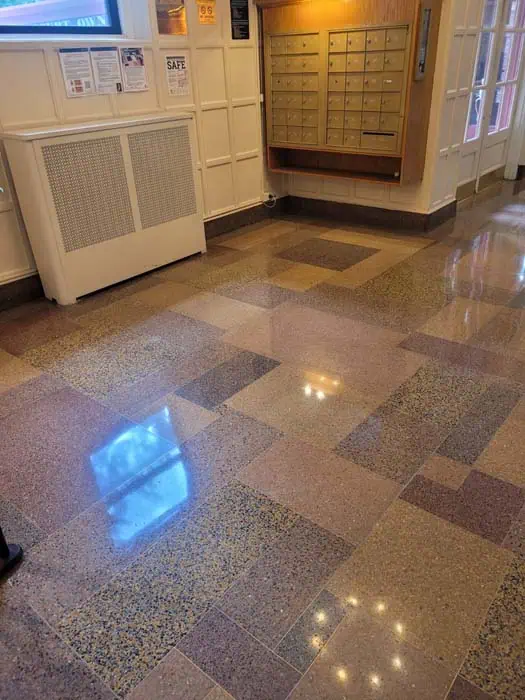
The marble floors in New York County building lobbies face conditions that residential floors simply don’t. A building with 200 residents sees foot traffic every hour of the day, year-round. Add the winter months — when road salt and de-icing chemicals get tracked in from the sidewalk — and you have a chemical etching problem layered on top of a mechanical wear problem. Salt reacts with calcium-based stone the same way acidic foods do: it breaks down the surface at a molecular level, leaving dull, pitted patches that no amount of polishing will fix.
For building managers and co-op boards, this creates a predictable maintenance cycle. Lobbies that aren’t properly refinished every few years accumulate damage that becomes progressively harder and more expensive to address. The salt etching from one winter isn’t catastrophic on its own. But five winters of etching on top of daily foot traffic, without proper professional refinishing in between, can take a lobby floor from restorable to requiring full replacement — which is a dramatically more expensive outcome.
The other factor specific to New York County buildings is the institutional environment. Co-op and condo boards typically require contractors to carry proof of insurance and often need to approve vendors before any work begins. This isn’t bureaucracy for its own sake — it protects the building and its residents. It also means that the company you hire needs to operate professionally from the first phone call, not just show up with equipment.
We work regularly with building managers and property management teams throughout New York County, and the most common thing we hear is that a previous company “polished” the lobby and it looked great for a month before returning to its previous state. That’s the polishing-vs-refinishing problem in practice. A lobby floor that’s been properly refinished — diamond-honed through the appropriate grit sequence and sealed correctly — will hold up to New York County winters and high foot traffic for years, not weeks.
Refinishing a Marble Countertop vs. Replacing It: What Most People Get Wrong
The most common reason people consider replacing a marble countertop is etching. The surface has gone cloudy in spots, maybe there are visible rings or dull patches from spills, and it no longer looks the way it did when it was new. The assumption is that the damage is permanent — that once marble etches, it’s done.
That assumption is almost always wrong. Refinishing a marble countertop means using diamond abrasives to remove the etched surface layer and restore the original finish — whether that’s a high-gloss polish or a softer honed look. The process is precise, takes a matter of hours for a standard kitchen countertop, and produces results that look like new stone because, in a real sense, you’re exposing new stone. The etched layer is gone.
To refinish a marble countertop properly, the technician needs to match the existing finish level. A honed countertop (matte, low-reflectivity) and a polished countertop (high-gloss, mirror-like) require different final steps in the diamond sequence. Getting this wrong is one of the more common mistakes made by generalist contractors who don’t specialize in stone — you end up with a countertop that’s technically smooth but doesn’t match the finish it had before. That’s why material-specific experience matters, not just general stone or tile experience.
Granite countertop refinishing follows a similar logic, though granite is a harder stone and more resistant to etching. Granite countertops tend to lose their polish gradually through abrasion rather than through chemical damage, so the presenting problem is usually a surface that looks dull and flat rather than cloudy or spotted. The fix is a professional refinishing sequence calibrated for granite’s hardness — different abrasives, different pressure, different final steps than you’d use on marble. A technician who treats granite and marble as interchangeable doesn’t fully understand either one.
The bottom line on countertop refinishing versus replacement: replacement costs dramatically more, takes longer, and in many cases produces a result that’s no better than what a skilled restoration would have achieved. The only situations where replacement genuinely makes more sense are structural damage — through-cracks, missing sections — or cases where the stone has been refinished so many times that there’s no material left to work with. For the vast majority of New York County kitchens and bathrooms we see, refinishing is the right answer.
How to Choose the Right Stone Refinishing Service in New York County
The most important thing you can do before hiring anyone to work on your stone is ask exactly what process they’re quoting. Not “polishing” or “restoration” as a label — but what steps are involved, what equipment they use, and how they’ll assess your surface before they start. A company that can answer those questions clearly and without overselling the scope of work is one worth trusting.
Before and after photos matter too. Anyone can describe a process; results on surfaces like yours are what actually tell you what to expect.
If you’re in New York County and you’re not sure whether your marble, granite, or countertop needs polishing, refinishing, or something more involved, Diamond Stone Restorations Corp offers free quotes and will give you a straight answer on what your surface actually needs — no upsell, no pressure. Reach out and we’ll take a look.