Summary:
If you’re standing in a Manhattan lobby or apartment foyer staring at a dull, scratched, or wax-coated terrazzo floor, you’re probably wondering two things: can this actually be fixed, and how do you find someone trustworthy to do it? Those are the right questions. Terrazzo restoration in New York County is genuinely different from anywhere else — the building types, the board approval process, the noise restrictions, the contractor requirements. We’ve designed this guide to give you real answers, not a sales pitch, so you know exactly what you’re dealing with before you pick up the phone.
What Refinishing Terrazzo Floors Actually Involves
“Refinishing” is one of those words that gets used loosely in the flooring world. Sometimes it means a light buff and polish. Other times it means a full diamond grind down to fresh material. The difference matters — both for cost and for what your floor actually needs.
Surface polishing works when the terrazzo is structurally sound but has lost its sheen. Diamond grinding is what’s called for when there’s real damage: deep scratches, etching, embedded stains, or years of wax buildup that cleaning alone can’t touch. Understanding which situation you’re in shapes everything that follows.
The Difference Between Surface Polishing and Full Terrazzo Restoration
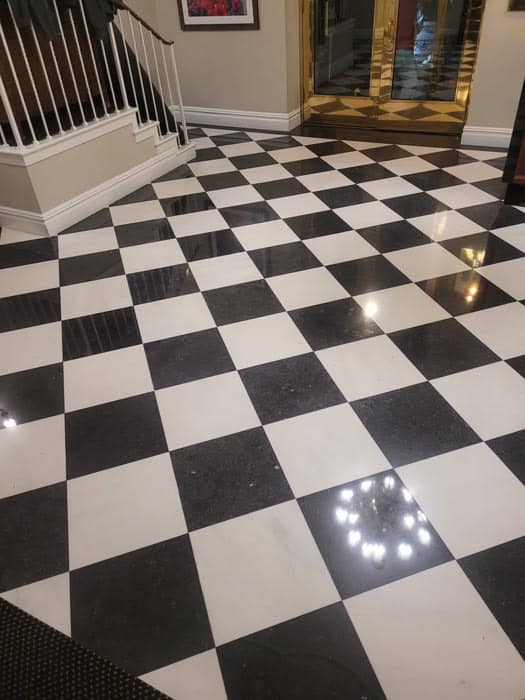
Think of it as a spectrum. At one end, you have a basic polish — using fine abrasive pads to bring back some shine to a floor that’s mostly in good condition. At the other end, you have a full restoration: diamond grinding through multiple grit levels, crack and chip repair, densification of the surface, and a final protective seal. Most floors that have been neglected for years, or maintained on a wax cycle, fall somewhere in the middle — but closer to the restoration end than most people expect.
The wax cycle is worth calling out specifically, because it’s one of the most common situations we see in New York County buildings. For decades, building supers applied acrylic polymer waxes to terrazzo as routine maintenance. Those coatings build up over time, yellow, trap dirt, and make the floor look perpetually grimy no matter how often it’s cleaned. Stripping that buildup is a necessary first step before any polishing or grinding can produce a real result.
Once the old coatings are stripped, the restoration process typically moves through progressively finer diamond abrasives — starting coarse to remove the damaged surface layer, then stepping up through medium and fine grits to refine the finish. For cement-based terrazzo, which is what you’ll find in most of New York County’s pre-war buildings, a densifier is applied after the coarse grinding phase to harden and crystallize the surface before fine polishing begins. This step is often skipped by less experienced operators, and the difference in the final result is visible.
Cracks and chips are addressed during the process with color-matched epoxy or resin fillers, ground flush with the surrounding floor. A properly matched repair is essentially invisible once the floor is polished. The job finishes with a sealer appropriate to the terrazzo type — penetrating for cement-based, topical for epoxy — and a final buff to bring the floor to its finished sheen.
Cement vs. Epoxy Terrazzo: Why the Type of Floor You Have Changes Everything
There are two main types of terrazzo, and the restoration approach differs significantly between them. Cement-based terrazzo is the older of the two — it’s what was installed in New York County’s pre-war co-op buildings, institutional lobbies, schools, and government offices throughout the early 20th century. Epoxy terrazzo came later and is more common in post-war commercial installations. The Guggenheim Museum’s floors, installed in 1959 when Frank Lloyd Wright specified terrazzo for the building, are a well-known example of that era’s craftsmanship.
Cement terrazzo is more porous and requires densification during restoration to prevent the surface from absorbing sealers unevenly. It also responds differently to diamond grinding — the aggregate and binder behave differently under abrasion than epoxy-based material. Using the wrong technique on cement terrazzo can cause uneven removal, visible swirl marks, or a finish that doesn’t hold up. Epoxy terrazzo, by contrast, is denser and more flexible, which affects both how it’s ground and what sealers are compatible with it.
If a contractor doesn’t ask which type of terrazzo you have before providing a scope of work, that’s a red flag. It suggests they’re applying a one-size-fits-all approach to a material that genuinely requires type-specific handling. The first question any qualified terrazzo contractor should ask — after looking at the floor — is whether it’s cement-based or epoxy-based, because that determination shapes every decision that follows.
For New York County property owners specifically, the odds are high that what you have is cement-based terrazzo, particularly in pre-war buildings on the Upper West Side, Upper East Side, Riverside Drive, or anywhere in Midtown’s older commercial stock. The Italian craftsmen who brought terrazzo to New York in the early 1900s worked almost exclusively in cement-based systems, and that original material is still underfoot in thousands of buildings across the county.
Hiring a Terrazzo Contractor in New York County: What to Ask Before You Book Anyone
Finding a qualified terrazzo contractor in New York County isn’t difficult. Finding one who understands how Manhattan buildings actually work — the board approval process, the work-hour restrictions, the insurance documentation requirements — is a different matter. Those details aren’t optional in this market. They’re the difference between a project that moves smoothly and one that stalls before it starts.
The questions below aren’t meant to trip anyone up. They’re meant to help you identify contractors who have genuinely done this work in New York County co-op and condo buildings before, versus those who are figuring it out on your job.

Do You Need Co-op or Condo Board Approval to Refinish Terrazzo in New York County?
This is the question that stops more New York County apartment owners from moving forward than any other. The short answer is: it depends on your building, but terrazzo restoration is generally classified as cosmetic or maintenance work rather than structural renovation — which means the approval pathway is typically simpler than what’s required for a kitchen remodel or bathroom gut renovation.
Most co-op and condo boards distinguish between structural alterations (which require formal alteration agreements, architectural drawings, and DOB filing) and cosmetic work (which may only require advance notice, proof of contractor insurance, and sometimes a simpler board notification). Refinishing an existing terrazzo floor — no removal, no structural change, no plumbing or electrical — usually falls into the cosmetic category. That said, every building has its own rules, and your managing agent is the right first call before you book anyone.
What boards consistently require, even for cosmetic work, is contractor documentation. General liability insurance and workers’ compensation coverage are standard requirements across virtually every New York County co-op and condo building. A contractor who can’t produce those certificates immediately, on request, is not someone you want to bring into a building with a board that will hold you accountable for their compliance. Ask for the certificates before the job starts, not after.
The other thing worth knowing is that common-area terrazzo — lobby floors, corridor floors, stairwell landings — is typically the building’s responsibility, not an individual unit owner’s. If you’re a board member or building manager looking at a lobby floor that’s been neglected for years, the approval process for restoration is generally straightforward because you’re the decision-maker. The complication arises for individual unit owners whose apartment foyers or interior rooms have terrazzo they want to restore — that’s where the alteration agreement question becomes relevant.
One practical note: the timeline from deciding to restore terrazzo to actually starting work in a New York County building can run two to four months when board approval is involved. Starting the contractor selection process early — before you have full approval — is a reasonable approach, as long as you’re not committing to a start date until the building gives the green light.
What a Legitimate Terrazzo Restoration Scope of Work Looks Like
One of the most common ways terrazzo restoration goes wrong in New York County is when a property owner accepts a vague proposal and discovers after the fact that what they thought was included wasn’t. A legitimate scope of work for terrazzo refinishing should be specific enough that you could hand it to a second contractor and get a comparable quote based on the same information.
At minimum, the scope should identify the type of terrazzo being restored (cement or epoxy), the square footage being addressed, and the specific steps included in the process. It should state whether crack and chip repair is included, how many grit levels will be used in the diamond grinding and polishing sequence, whether densification is part of the process (for cement terrazzo), and what type of sealer will be applied at the end. If the contractor is stripping existing wax or coatings before beginning, that should be called out explicitly — it’s labor-intensive work that affects both the timeline and the cost.
What a scope of work should not do is use vague language like “polish and seal” without specifying what that means in practice. “Polish” can mean anything from a light machine buff to a multi-stage diamond progression. The difference in labor, equipment, and outcome is significant. If a proposal doesn’t distinguish between the two, ask the contractor to clarify in writing before you sign anything.
A few other things worth confirming before any work begins: ask how the contractor plans to manage dust containment during grinding (this matters a great deal in apartment buildings where hallways and common areas are shared), confirm the work hours they’ll observe (most New York County buildings restrict contractor work to weekdays between 9am and 5pm, and some have additional restrictions around noise-generating equipment), and ask whether they’ll provide elevator and hallway protection during the job. These aren’t unreasonable questions — they’re standard operating procedure for any contractor who has worked in New York County residential buildings before. A contractor who seems unfamiliar with these requirements, or who pushes back on them, is telling you something important.
After the job is complete, you should receive specific guidance on how to maintain the restored floor going forward. Properly restored and sealed terrazzo doesn’t need waxing. It needs regular sweeping and occasional damp mopping with a neutral pH cleaner. If a contractor finishes the job and doesn’t tell you this, ask — because the single fastest way to undo a quality restoration is to start applying wax products that will rebuild the same buildup cycle you just paid to eliminate.
Terrazzo Restoration in New York County: What to Do Next
The floors in New York County’s older buildings are worth preserving. Terrazzo installed by Italian craftsmen a century ago, in the lobbies and foyers of pre-war buildings across the Upper West Side, Upper East Side, and Midtown, is irreplaceable. Restoration keeps that material intact. Replacement destroys it — and costs significantly more in the process.
If you’re a building manager, co-op board member, or apartment owner dealing with a terrazzo floor that’s been neglected, wax-coated, or damaged, the path forward is more straightforward than it probably feels right now. Know what type of terrazzo you have, get a specific scope of work in writing, confirm the contractor’s insurance documentation before anything starts, and check with your managing agent about your building’s requirements for cosmetic work.
We work with residential and commercial clients across New York County and the broader NYC area. If you’d like to talk through what your floor actually needs — without a hard sell — reach out to Diamond Stone Restorations Corp for a free quote.