
Summary:
If you’ve ever stood in a New York County lobby staring at a dull, worn floor and genuinely weren’t sure whether it was terrazzo or marble, you’re not alone. It’s one of the most common questions we hear — and it matters more than most people realize. These two surfaces look similar when they’re neglected, but they’re built completely differently. They wear differently, stain differently, and need entirely different approaches to restore properly. Use the wrong process on either one and you can cause permanent damage. This guide walks you through what sets them apart, what restoration actually involves for each, and how to figure out which surface deserves your attention first.
Refurbishing Terrazzo Floors: What the Process Actually Involves
Terrazzo is a man-made composite — marble chips, quartz, granite, or glass set into either a cement or epoxy binder, then ground flat and polished. It was engineered to be durable, which is why so many of New York County’s pre-war lobbies still have their original terrazzo floors after 80 or 100 years of foot traffic. The material doesn’t just hold up — it’s designed to be refinished. The aggregate chips run through the full depth of the slab, which means there’s always more pristine surface below whatever damage is visible on top.
Marble is different. It’s a natural metamorphic rock — calcium carbonate that’s been compressed and recrystallized over millions of years. It’s beautiful and it’s genuinely hard, but it’s also porous, acid-sensitive, and less forgiving once wear patterns set in deep. Understanding that distinction is the starting point for everything else.

How to Tell Terrazzo and Marble Apart Before You Do Anything
The single most important thing you can do before attempting any restoration — DIY or professional — is confirm which surface you’re actually dealing with. Treating terrazzo like marble, or marble like terrazzo, produces bad results. In some cases, it causes irreversible damage.
Here’s a practical way to tell them apart. Terrazzo will show visible aggregate — small chips of marble, glass, or stone suspended in the background material. If you look closely at the floor under decent light, you’ll see that it’s made up of pieces rather than a continuous natural pattern. Marble, by contrast, has veining that flows organically through the stone. No two slabs are identical, and the pattern doesn’t repeat in the way terrazzo does across a large floor.
There’s also the composition of the binder to consider. Cement-based terrazzo — common in buildings constructed before the 1970s — is porous and prone to staining. Epoxy terrazzo, which became more widely used in later decades, is non-porous and far more resistant to moisture and chemicals. This distinction matters for restoration because the products and techniques used on cement terrazzo can be wrong for epoxy terrazzo, and vice versa. A good restoration specialist will assess which type you have before touching anything.
One more thing worth knowing: a significant number of New York County’s pre-war buildings have terrazzo floors that were covered over with carpet or linoleum sometime in the mid-20th century, often because wax buildup made them look so bad that building managers assumed they were ruined. If you’ve pulled up old flooring in a pre-war building and found something that looks like speckled concrete with colored chips in it, there’s a real chance you’ve uncovered original terrazzo that’s been hidden for decades — and it’s very likely restorable.
The first U.S. terrazzo installation was built in 1890 at the Vanderbilt residence on Fifth Avenue. Italian immigrant craftsmen brought the trade to New York County between 1900 and 1915, and by the 1920s and 1930s, terrazzo had become the standard flooring choice for building lobbies, stairwells, and institutional spaces across the region. Radio City Music Hall and the Solomon R. Guggenheim Museum both have original terrazzo floors from that era. If your building dates from that period, there’s a good chance the floor under your feet is historically significant — and fully restorable.
What Refurbishing Terrazzo Floors Actually Looks Like Step by Step
The process for refurbishing terrazzo floors starts with a thorough assessment — not a glance at the floor, but a real evaluation of the terrazzo’s composition, the type and depth of damage, and what the surface has been through. Has it been waxed for years? Are there cracks or chips? Is the binder cement or epoxy? The answers determine everything that follows.
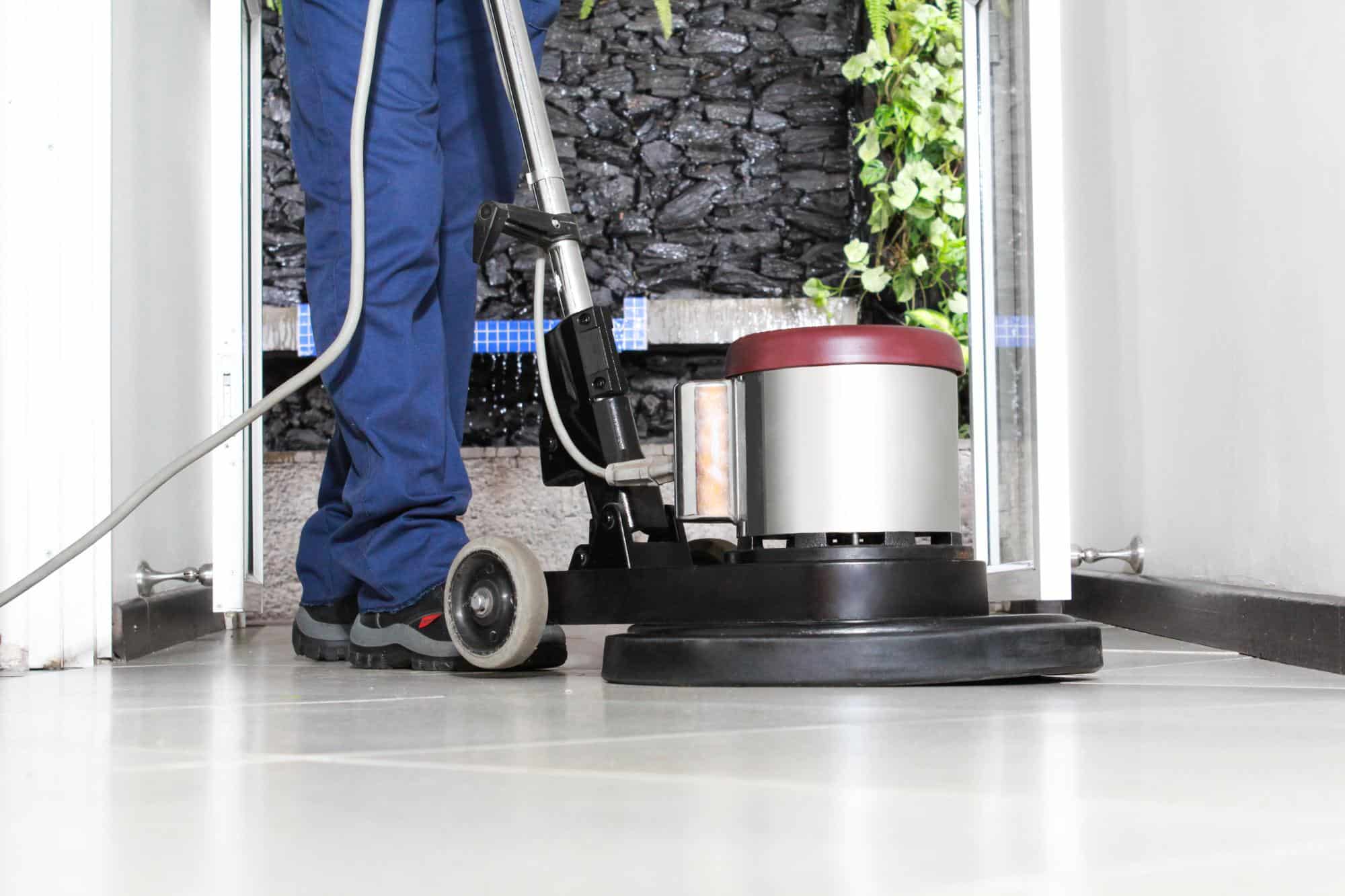
From there, the work begins with diamond abrasive grinding. This isn’t sanding in the conventional sense — it’s a controlled mechanical process using progressively finer diamond grits to remove the damaged surface layer and expose the undamaged material below. The number of steps in this process depends on the condition of the floor. A floor with heavy wax buildup, surface scratches, and minor staining might require more aggressive starting grits before working up to the finer ones. A floor that’s simply dull from age might need fewer passes. Skipping steps to save time produces uneven results that won’t last.
Once the grinding is complete, any cracks or chips are repaired using color-matched epoxy fills that blend with the original aggregate. This step is critical — cracks left unaddressed will worsen over time, and filling them correctly requires matching the original material closely enough that the repair becomes nearly invisible.
The final stage is sealing or vitrification. Vitrification — from the French meaning “to make glass-like” — chemically alters the surface composition to produce a hard, high-gloss finish that resists staining and heavy foot traffic. This is distinct from applying a topical wax or coating. It works at the surface level of the stone itself, which is why the results last so much longer. After professional diamond polishing and vitrification, terrazzo maintenance comes down to sweeping and damp mopping — no wax, no stripping, no quarterly treatments.
One of the most common situations we see in New York County is a terrazzo floor that’s been waxed for decades by building maintenance staff doing their best with the tools they had. Wax builds up, traps dirt, and creates a yellowish film that makes the floor look permanently stained. It also masks the real surface underneath. Removing that wax and restoring the original terrazzo often reveals a floor that’s in far better condition than anyone expected.
Marble Floor Refinishing: Why Marble Needs a Different Approach
Marble gets damaged in ways terrazzo doesn’t. Because it’s calcium carbonate, it reacts chemically with acids — and acids are everywhere. Vinegar, lemon juice, certain cleaning products, even rainwater in some conditions will etch marble on contact. Etching isn’t surface dirt you can clean off. It’s actual structural damage to the stone that leaves dull, slightly rough patches where the surface has been chemically dissolved. No amount of mopping fixes it.
This is why building managers in New York County often feel like they’re fighting a losing battle with marble lobby floors. The floor gets cleaned, it still looks dull, it gets cleaned again, and the dullness gets worse. The cleaning products are often the problem.

How Marble Floor Refinishing Removes Etching and Restores the Surface
Marble floor refinishing uses the same diamond abrasive technology as terrazzo restoration, but the process is calibrated differently for marble’s specific characteristics. The goal is to remove the etched or scratched surface layer and work down through progressively finer grits until the stone is smooth, uniform, and ready to take a polish.
The distinction between honing and polishing matters here. Honing uses coarser diamond abrasives to remove deeper damage — scratches, etching, surface unevenness. Polishing follows with finer grits to bring the stone to its final sheen, whether that’s a high-gloss mirror finish or a softer honed look. The right finish depends on the marble type, the original specification of the floor, and the building’s practical needs. A residential foyer in a pre-war Upper West Side apartment might call for a different result than a commercial lobby in Midtown.
Different marble varieties respond differently to the refinishing process, and a specialist needs to know which one they’re working with. Carrara marble — the most common variety in New York County’s pre-war residential buildings — is relatively soft and more prone to etching than denser varieties. Calacatta, which is often confused with Carrara, is slightly harder and has bolder veining. Crema Marfil and Emperador behave differently again. Applying a one-size-fits-all approach to marble refinishing produces inconsistent results.
There’s also the issue of iron staining. Marble contains trace amounts of iron sulfide — pyrite — which can develop orange or rust-colored stains over time as moisture moves through the stone. These stains can be treated, but if the iron is deep within the stone rather than on the surface, the staining will recur after treatment. Understanding this before you start helps set realistic expectations and guides the choice of treatment method.
After refinishing, marble requires sealing to protect the restored surface. Unlike terrazzo, which becomes highly resistant to staining after diamond polishing, marble remains porous and needs resealing every one to three years depending on traffic and the type of finish. This is ongoing maintenance, not a one-time fix — and it’s something worth factoring into a building’s maintenance schedule.
Natural Stone Floor Care After Restoration: How to Make the Results Last
The most common reason restored floors look bad again within a year or two isn’t the quality of the restoration — it’s what happens after. Natural stone floor care is simple once you know the rules, but the wrong products undo professional work quickly.
For both terrazzo and marble, the non-negotiable is pH-neutral cleaners. Anything acidic — and that includes a lot of common household and commercial floor cleaners — will etch marble and can degrade terrazzo’s binder over time. The label doesn’t have to say “acid” for it to be a problem. Citrus-based cleaners, vinegar solutions, and many general-purpose floor sprays fall into this category. A pH-neutral cleaner formulated for natural stone is the right tool, and it’s worth making sure your building’s maintenance staff knows which products are on the approved list.
For terrazzo specifically, after professional diamond polishing the maintenance routine is genuinely low-effort. Sweep or dry mop regularly to remove grit — grit is abrasive and will dull any polished surface over time if it’s left to be walked on. Damp mop with a pH-neutral cleaner as needed. That’s largely it. The diamond-polished surface is hard, dense, and resistant to staining in a way that waxed terrazzo never was. You’re not stripping and reapplying anything. You’re not scheduling quarterly treatments. The floor just needs to be kept clean.
Marble requires a bit more attention. Beyond the pH-neutral cleaner rule, sealing on schedule matters. A properly sealed marble floor resists staining and is easier to maintain, but the sealant wears down with traffic and needs to be reapplied. For a high-traffic New York County lobby, that might mean resealing annually. For a residential marble bathroom floor, every two to three years is typically sufficient. Catching etching early also makes a difference — minor etching addressed quickly is a simpler refinishing job than deep etching that’s been walked on and worsened for two years.
One thing worth mentioning for New York County property managers specifically: winter is hard on lobby floors. Salt, grit, and moisture tracked in from the street between November and March are abrasive to both terrazzo and marble. A good entrance mat system catches a lot of that before it reaches the stone, and spring is a natural time to assess whether the lobby floor needs professional attention after the season’s wear. We see a consistent pattern of building managers scheduling assessments in March and April once the worst of it is over.
Which Surface Should You Restore First — and How We Can Help
If your building has both terrazzo and marble — which is common in New York County’s pre-war and mid-century stock — the answer to “which one first” usually comes down to condition and traffic. A heavily etched marble lobby floor that’s being cleaned with the wrong products will keep getting worse. Terrazzo that’s been waxed for decades is already in a maintenance cycle that’s costing money and producing poor results. Either way, the first step is knowing exactly what you have and what it actually needs.
The wrong diagnosis leads to the wrong treatment. And in a region where these floors are often 70, 80, or 100 years old, the wrong treatment can mean permanent damage to something irreplaceable.
If you’re managing a building in New York County, NY and you’re not sure what you’re looking at — or you know what you have but you’re not sure what to do about it — we offer free assessments. Reach out, describe what you’re seeing, and we’ll tell you honestly what the floor needs and what the process looks like from there. Diamond Stone Restorations Corp. has been restoring natural stone floors throughout New York County for years, and we’re here to help you make the right decision for your property.