
Summary:
You’ve found a contractor you trust. The quote looks fair. The before-and-after photos are convincing. And then the building board rejects the insurance certificate, and everything stalls.
This is the most common reason stone tile restoration projects in New York County co-ops never get started — not the work itself, but the paperwork surrounding it. New York County co-op and condo buildings operate under a completely different set of rules than private homes, and most contractors who do excellent work in one setting are completely unprepared for the other.
Here’s what you actually need to know before scheduling anything.
Why New York County Co-op Buildings Have Stricter Rules Than Private Homes
In a private home, you hire a contractor, they show up, and the work gets done. In a New York County co-op, you don’t own your apartment outright — you own shares in a corporation that owns the building. That legal structure changes everything about how renovation and restoration work is handled.
The building corporation has a direct financial and legal stake in any work performed inside your unit. If a contractor damages a shared wall, floods a neighboring apartment, or creates a liability issue, the building — not just you — is exposed. That’s why co-op boards require contractors to carry specific insurance coverage, name the building as an additionally insured party, and often sign a formal alteration agreement before a single tool is unpacked.

What Is an Alteration Agreement and Does Stone Restoration Require One?
An alteration agreement is a contract between the shareholder and the building corporation that outlines exactly what work will be done, who is responsible for damages, and what documentation the contractor must provide before work begins. It’s the building’s way of protecting itself — and every other shareholder in the building — from the consequences of a poorly managed project.
Here’s where a lot of New York County co-op shareholders get tripped up: they assume that stone tile restoration is cosmetic work and therefore exempt from the alteration agreement process. In many buildings, that assumption is wrong. Even when a project doesn’t require a permit from the NYC Department of Buildings, the co-op board may still require an alteration agreement if the work involves grinding equipment, moisture, or any process that could affect shared building systems or adjacent units.
Stone tile restoration — particularly marble polishing or terrazzo grinding — involves vibration, water, and fine particulate dust. In a high-rise building where units share walls, ceilings, and mechanical systems, those factors matter. A building superintendent who sees grinding equipment in a hallway without an approved alteration agreement on file has every right to issue a stop-work order.
The consequences of starting work without board approval can be serious. Security deposits — which typically range from $5,000 to $20,000 in New York County co-ops — can be forfeited. Daily fines for unauthorized work can reach $500 or more. And in some cases, the board can require the shareholder to restore the apartment to its original condition at their own expense. None of that is worth the shortcut.
The practical takeaway: before you schedule any stone restoration work in a New York County co-op, contact your managing agent and ask directly whether an alteration agreement is required. Don’t assume. The answer varies by building, and the managing agent — not the board — is usually the first person who reviews contractor documentation anyway.
What a Proper Certificate of Insurance Must Include for New York County Co-op Stone Work
This is where most projects hit a wall. A contractor can be fully licensed, genuinely skilled, and properly insured — and still get rejected by a New York County co-op board because the Certificate of Insurance (COI) doesn’t say exactly the right things.
New York County co-op boards require contractors to carry commercial general liability (CGL) insurance at a minimum of $1 million per occurrence and $2 million aggregate. Many buildings in New York County — particularly luxury high-rises and pre-war properties — require umbrella coverage of $5 million to $10 million on top of that for higher-end renovation scopes. Workers’ compensation insurance is also mandatory in New York State for any contractor with employees, and the certificate must be presented separately.
But the coverage amounts alone aren’t enough. The single most common reason a COI gets rejected is missing or incorrect “additionally insured” language. In a co-op building, the contractor’s policy must name the building corporation as an additionally insured party — not just the shareholder who hired them. Many buildings also require the managing agent and the unit owner to be named. That language has to appear on the actual certificate, not just in the underlying policy. A verbal confirmation from the insurance company that the coverage exists is not sufficient.
There’s also a timing issue that catches people off guard. The COI must be active for the entire duration of the project. If the certificate lapses mid-project — even by a day — the building board has the right to issue a stop-work order and halt everything until updated documentation is provided. For a stone restoration project scheduled across multiple days, that’s a real operational risk if the contractor’s policy is close to renewal.
One more thing worth knowing: the NYC Department of Consumer and Worker Protection (DCWP) issues Home Improvement Contractor licenses and requires contractors to carry general liability insurance naming DCWP as a certificate holder at 42 Broadway, New York, NY 10004. If your contractor is licensed through DCWP — which they should be for any work in a residential building — that certificate holder language needs to be on file as well. A contractor who can’t produce that documentation quickly is a red flag.
At Diamond Stone Restorations Corp, we work in New York County co-op and condo buildings regularly. We know what the documentation package needs to look like, and we can produce it without putting the burden on you to chase it down.
Professional Stone Restoration Services in New York County: What the Process Actually Looks Like
Once the documentation is in order and the board has signed off, the actual restoration work is straightforward — but it’s worth understanding what professional stone tile restoration involves, because a lot of people have a distorted picture of it.
Restoration is not cleaning. It’s not applying a product from a hardware store and buffing it out. Professional surface restoration services involve a multi-step process: a thorough assessment of the stone’s condition, cleaning to remove surface contamination, grinding and honing with diamond abrasives to remove physical damage like scratches and etch marks, polishing to restore the stone’s natural luster, and finally sealing to protect the surface against future damage. Each step matters, and skipping any one of them produces a result that won’t hold up.
What Professional Stone Restoration Fixes — and What It Can't
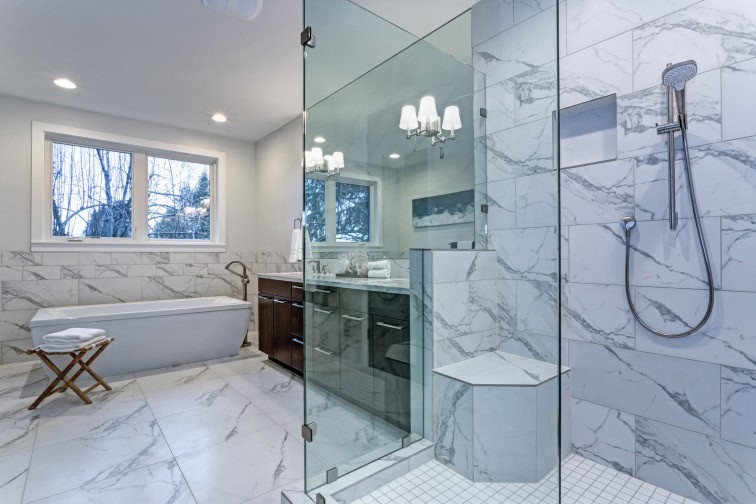
Professional stone restoration can address a wide range of damage that most property owners assume is permanent. Etch marks from acidic cleaners on marble — the dull, cloudy spots that appear after contact with lemon juice, vinegar, or harsh household products — are removed through the honing and polishing process. Deep scratches, surface staining, and the general dullness that accumulates on high-traffic floors over years of use are all within the scope of what professional stone restoration handles.
What restoration can’t do is replace missing material. If a section of tile is cracked through completely, or if a chip has removed a significant portion of the stone’s surface, restoration can improve the appearance of the damage but won’t make it invisible. A thorough assessment before any work begins should clarify exactly what outcomes are realistic for your specific surfaces — and any contractor who promises to make severe physical damage disappear entirely is overpromising.
In New York County buildings, this assessment step is particularly important for pre-war properties. Many buildings constructed in the 1920s through the 1950s feature original terrazzo lobby floors, marble wainscoting, and stone bathroom tile that simply cannot be replicated with modern materials. When that stone is damaged, the goal is preservation — not perfection — and understanding that distinction upfront leads to better outcomes and fewer disappointments.
The other thing worth knowing is that the sealing step at the end of the process is not cosmetic. A penetrating sealer applied after polishing protects the stone against moisture, staining, and the mineral buildup that New York City’s hard water supply accelerates on marble and limestone surfaces. We apply two coats of sealant as standard — not one, which is what most contractors offer. That second coat makes a measurable difference in how long the results last in a high-use environment like a New York County apartment or building lobby.
Finding a Marble Sealing Company That Can Actually Work in Your New York County Building
Here’s a practical problem that doesn’t get discussed enough: a lot of skilled stone restoration contractors — including many who do excellent work in private homes and suburban properties — have never navigated the documentation requirements of a New York County co-op or condo building. They’re not cutting corners intentionally; they just haven’t worked in this market before. And when the managing agent asks for a COI with specific additional insured language and a workers’ comp certificate naming the building, the contractor doesn’t know what that means or how to get it done quickly.
That gap creates real delays. New York County co-op boards often review renovation packages in December and January so that approved projects can begin in early spring — and if a contractor’s documentation is incomplete at the time of submission, the project may not get approved until the next review cycle. That’s months of waiting, not days.
When you’re evaluating a marble sealing company or any stone restoration contractor for work in a New York County building, the questions to ask are direct: Have you worked in co-op buildings before? Can you produce a COI with additional insured language naming the building corporation within 24 hours? Do you carry workers’ compensation insurance? Are you licensed through DCWP? If the answers are slow or uncertain, that’s useful information.
Beyond documentation, the other factor that matters in apartment buildings is dust containment. New York County co-op boards — particularly in buildings with elderly residents or strict air quality standards — increasingly require contractors to seal work areas with plastic sheeting and use HEPA filtration during any grinding or polishing work. A contractor who doesn’t have a clear dust containment protocol puts you at risk of neighbor complaints and potential stop-work orders, regardless of how good the finished work looks.
We’ve restored marble, terrazzo, and natural stone tile in buildings across New York County — from individual apartment bathrooms to 40-year-old lobby floors in six-story residential buildings. The documentation, the containment protocol, the scheduling within building work-hour restrictions — all of it is part of how we operate, not something we figure out on the fly.
Stone Tile Restoration in New York County: The Short Version
The work itself — restoring marble, terrazzo, or natural stone tile to something better than it’s looked in years — is the straightforward part. What slows projects down in New York County is almost always the documentation layer: an incomplete COI, missing additional insured language, an alteration agreement that wasn’t submitted in time, or a contractor who’s never worked in a managed building before.
Getting that right from the start means your project moves forward on your schedule, not the board’s review calendar. It also means you’re not the shareholder fielding complaints from neighbors about dust, or the property manager dealing with a stop-work order on a job that was supposed to finish last week.
If you’re planning stone tile restoration in a New York County co-op or condo building and want to work with a contractor who already knows the process, Diamond Stone Restorations Corp is ready to help. Reach out for a free estimate and we’ll walk you through exactly what the documentation package looks like for your building.