
Summary:
If you’ve ever gotten three quotes for your marble and received three completely different recommendations, you’re not imagining things. One company says you need polishing. Another says restoration. A third throws in “honing” without really explaining what it means. And somehow the prices are all over the place.
This happens because these four terms — refinishing, polishing, honing, and restoration — get used interchangeably in this industry, even though they describe genuinely different processes with different costs and different results. Understanding the distinction isn’t just useful background knowledge. It’s the thing that prevents you from paying for the wrong service, or worse, paying for the right one twice.
Natural Stone Restoration: What the Four Processes Actually Mean
Think of these four treatments as a spectrum — from light cosmetic work on a surface that’s mostly fine, all the way to a full mechanical rebuild of a stone that’s been through decades of hard use. Where your marble falls on that spectrum determines which process it actually needs.
Polishing is the lightest touch. It’s a surface-level treatment designed to restore gloss and clarity on marble that has minor dullness or surface haze — but no real structural damage underneath. Refinishing goes a step further. It involves resurfacing treatments that alter the finish level of the stone, removing a thin layer to address light scratching or to change the surface character. Honing creates a matte or satin finish by working the stone with diamond abrasives at intermediate grit levels — it’s both a repair method and a deliberate design choice. Full restoration is the most comprehensive option: a multi-stage process for marble with significant scratching, etching, staining, cracks, or heavy wear that polishing alone can’t fix.

Why Polishing Alone Fails on Etched or Scratched Marble
This is the most common and costly mistake we see in New York County. A property owner notices their marble is dull, hires someone to polish it, and the results look great — for about two weeks. Then the dullness comes back, sometimes worse than before. It feels like the work didn’t hold.
Here’s what actually happened: polishing puts a gloss layer over the surface of the stone. If the underlying marble has etching — the chemical damage caused by acids in food, cleaning products, or even the mild acids tracked in from Manhattan streets — that damage is still there underneath. You’ve covered it temporarily, but you haven’t removed it. The moment the gloss layer wears down even slightly, the etching shows right through again.
Etching is a physical change to the stone’s surface structure. Acids react with the calcium carbonate in marble and leave behind a dull, slightly rough patch that catches light differently than the surrounding stone. No amount of polishing compound fixes that — you need to mechanically remove the damaged layer first, which is what honing does.
This is why the sequence matters so much. Honing uses diamond abrasive pads at intermediate grit levels — typically in the 200 to 800 grit range — to grind away the damaged surface layer and create a uniformly smooth base. Only after that foundation is established does polishing produce a result that actually lasts. Skipping the honing step on etched marble is like painting over rust. It looks fine immediately and falls apart quickly.
In New York County kitchens especially, where marble countertops live next to citrus, vinegar, wine, and cleaning sprays, acid etching is essentially a given over time. A surface-only polish refresh will always be a temporary fix on a countertop that sees regular cooking use. The right answer there is usually honing followed by polishing — or simply a honed finish, which hides future etching far better than a high-gloss surface does.
When Is Honing a Design Choice, Not Just a Repair?
Most people encounter honing as a solution to a problem — their marble is etched, scratched, or uneven, and honing is the step that fixes it before polishing begins. But there’s a growing segment of New York County homeowners and designers who choose a honed finish intentionally, not because something went wrong.
A honed finish has a matte, satin-like quality. It doesn’t reflect light the way polished marble does, which gives it a more understated, contemporary look that’s been trending in high-end residential interiors for several years. You see it frequently in modern kitchen renovations in the West Village, in bathroom remodels in newer Tribeca buildings, and in the common areas of design-forward condominiums across the borough.
The practical argument for honed marble in kitchens and bathrooms is also compelling. Because the surface isn’t highly reflective, etching and watermarks are far less visible on a honed finish than on polished marble. You’re not eliminating the damage — you’re choosing a finish that makes it much harder to see in daily use. For high-traffic surfaces that will inevitably encounter acids and moisture, that’s a meaningful quality-of-life difference.
Converting polished marble to a honed finish is a slightly more involved process than a standard polish refresh — it requires working through the diamond abrasive sequence in reverse, so to speak, stopping at a lower grit rather than continuing to the high-gloss range. That additional step typically adds around 10 to 20 percent to the cost compared to a straightforward polish. But for the right surface in the right space, it’s an upgrade that changes how the stone ages over time, not just how it looks on the day of the job.
The key point is that honing isn’t exclusively a repair process. If you’re drawn to the look of matte marble and you want a surface that holds up better in everyday use, it’s a legitimate finish choice worth discussing before any work begins.
Polishing Marble Countertops vs. Full Marble Restoration: How to Tell Which One You Need
Countertops and floors develop damage differently, and that affects which process makes sense. A marble floor in a busy New York County lobby accumulates wear from foot traffic, grit, and the abrasive road salt that gets tracked in from the street every winter — that kind of wear tends to cause widespread surface scratching and lippage over time. A marble countertop, by contrast, takes concentrated hits: a dropped pan, a lemon left sitting overnight, cleaning sprays used daily. The damage is often more localized but can be chemically deeper.
Polishing is the right call when the marble is fundamentally sound — no deep scratches, no etching, no cracks — and the goal is simply to bring back the clarity and gloss that’s faded with normal use. Full restoration is the right call when the damage goes beyond the surface: when there are visible scratches that catch your fingernail, etch marks that don’t respond to cleaning, chips or cracks, or sections where the stone has worn unevenly.

Marble Countertop Repair: What Full Restoration Actually Involves
Full restoration is a multi-stage process, and understanding what each stage does helps you evaluate whether a quote you’ve received is actually covering what your marble needs.
It starts with a thorough deep clean to remove embedded residue, surface films, and anything sitting in the stone’s pores that would interfere with the mechanical work. From there, the process moves into honing — working through a progressive sequence of diamond abrasive pads to remove the damaged surface layer, eliminate scratches and etch marks, and create a uniformly smooth base. The grit progression matters here: starting too coarse on marble that only needs light work creates unnecessary removal, while starting too fine on heavily damaged marble means the work takes far longer and may not fully address the damage.
Crack and chip repair happens after honing, using color-matched two-component epoxy to fill structural damage before the final surface work begins. This step requires real material knowledge — matching the fill to the specific stone’s color and veining character so the repair integrates rather than stands out. New York County’s older buildings contain a remarkable variety of marble — Carrara, Calacatta, Nero Marquina, and other varieties with distinct visual characters — and a repair that looks seamless on one stone can look obvious on another.
After honing and any structural repairs, the stone is brought to its final finish level — polished, honed, or somewhere in between — and then sealed. Sealing is not optional. Marble is porous, and an unsealed surface after restoration will stain faster than the original stone did, because the honing process has opened the surface slightly. The seal is what protects the investment.
What full restoration is not is a quick job. A countertop that needs all of these steps done properly takes time. Anyone quoting a full restoration on a heavily damaged surface in under an hour is almost certainly cutting steps — and those shortcuts are exactly why some property owners end up calling us back six months later.
Honing Marble Floors in New York County Buildings: What Makes It Different
Marble floors in New York County’s pre-war co-ops, condo lobbies, and commercial buildings present a specific set of challenges that residential countertop work simply doesn’t. The scale is larger, the damage patterns are different, and the logistics of working in a shared building environment add a layer of complexity that matters.
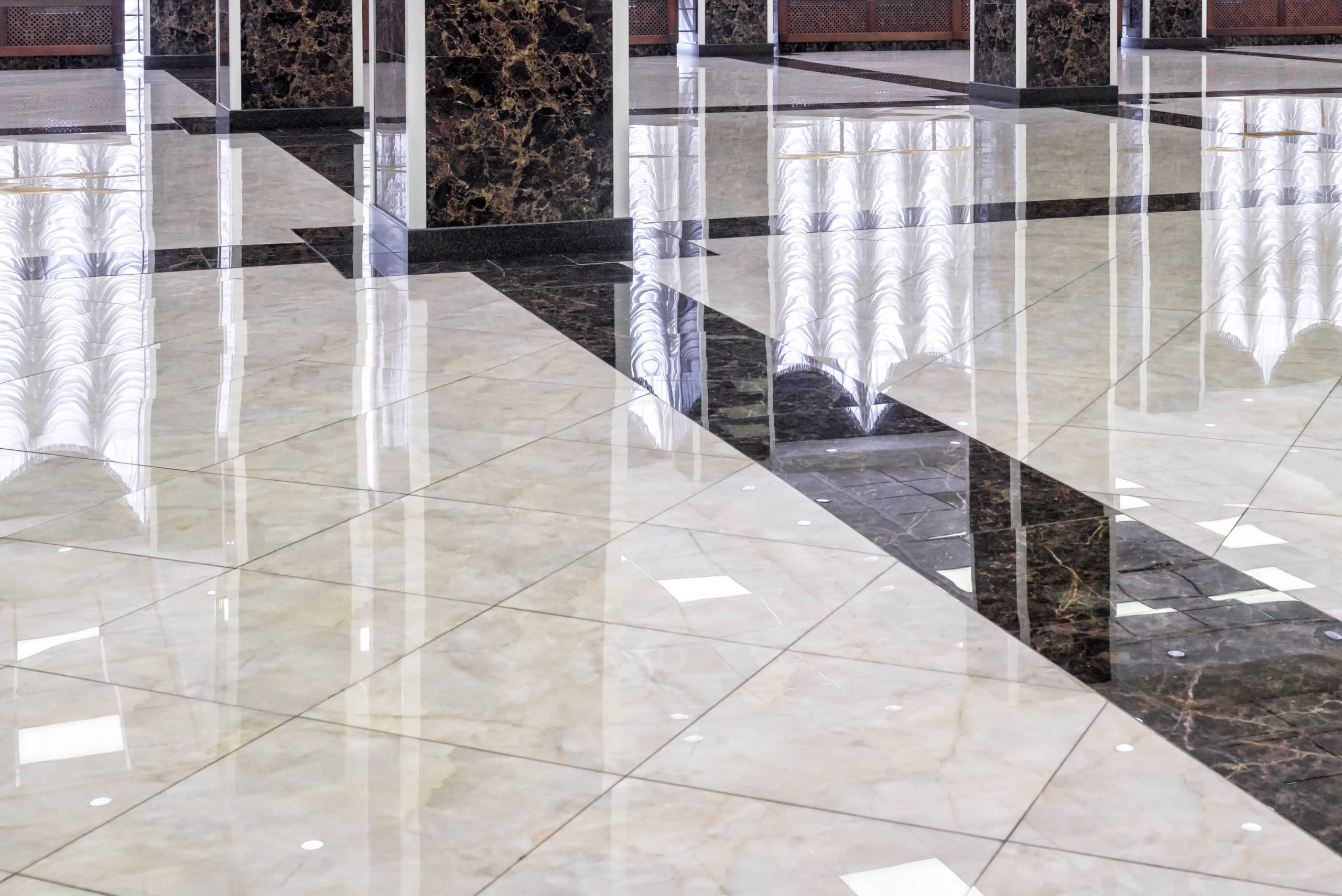
Traffic wear on marble floors tends to be widespread rather than concentrated. High-traffic paths — the line from the elevator to the front door, the area in front of a reception desk — show wear patterns that are visually distinct from the lower-traffic sections of the same floor. When we’re honing and polishing a large floor, the goal is to bring the entire surface to a uniform finish level, which means the process has to account for varying degrees of wear across different zones of the same stone.
Lippage — the height difference between adjacent stone tiles where one has settled slightly higher or lower than its neighbor — is another floor-specific issue that countertop work doesn’t involve. Addressing lippage requires grinding down the higher edges to create a level surface before any polishing work begins. It’s a step that adds time and cost but makes a significant difference in the final result, both visually and in terms of how the floor wears going forward.
For New York County buildings specifically, the logistics of floor restoration involve a few realities that don’t apply in suburban markets. Work in a co-op or condo building typically needs to be coordinated with building management and scheduled around elevator access, common area availability, and noise restrictions. Building boards often have opinions about what treatments are acceptable, particularly in landmark-designated buildings where the Landmarks Preservation Commission may have a say in what materials and methods can be used on original surfaces. Restoration — which preserves the original stone rather than replacing it — is frequently the only approach that satisfies both the building’s practical requirements and any applicable preservation guidelines.
We’ve worked on marble floors across New York County for more than a decade, including large-scale commercial projects covering multiple stories of a building in a single engagement. The scale changes the logistics, but our standard for the work doesn’t.
Choosing the Right Marble Refinishing Service in New York County
The most important thing you can do before any work begins is get an honest assessment of what your marble actually needs — not what’s easiest to sell, and not what sounds most impressive. The difference between a polish refresh and a full restoration is real, and so is the difference in cost and longevity. Understanding which one applies to your situation puts you in a far better position to evaluate any quote you receive.
If your marble has been polished before and the results didn’t last, that’s a signal worth paying attention to. If you’re looking at a floor with visible wear patterns or a countertop with etch marks that cleaning doesn’t touch, polishing alone isn’t going to solve it. And if you’re considering a honed finish for design reasons, that’s a completely valid choice — it just needs to be done correctly from the start.
Diamond Stone Restorations Corp works with residential and commercial clients across New York County. If you’re not sure what your marble needs, a free estimate is the right place to start — we’ll tell you exactly what we’re seeing and what we’d recommend, without padding the scope.