Summary:
If your commercial floors look dull even after mopping, or you’ve noticed that yellowish haze creeping in near the edges and high-traffic zones, you’re not imagining it. That’s what floor finish failure looks like — and adding another coat of wax on top won’t fix it. It’ll make it worse.
Floor stripping and waxing is one of those services that gets treated like a commodity in New York County. Any cleaning crew, any product, any sequence — same result, right? Not quite. The way this job is done determines whether your floors look sharp for months or start degrading within weeks. Here’s what you actually need to know.
What Floor Waxing Actually Does — and When It Stops Working
Commercial floor wax — more accurately called floor finish — isn’t decorative. It’s a protective coating that sits between your floor’s surface and everything that walks across it: foot traffic, grit, moisture, cleaning chemicals, and the salt and debris that New York County winters drag in from the sidewalk. Without it, the floor substrate itself takes the abuse.
The problem is that floor finish has a lifespan. In a moderate-traffic office, that might be 12 months before the finish degrades enough to warrant a full strip-and-recoat. In a New York County building lobby processing hundreds of entries per day — plus the grit and road salt tracked in from the subway and street — that cycle compresses significantly. Six months is a more realistic benchmark for high-traffic areas. When the finish breaks down, routine mopping and buffing can only do so much. At a certain point, you need to start fresh.
Signs Your Commercial Floor Needs a Full Strip, Not Just a Buff
There’s a meaningful difference between a floor that needs buffing and one that needs stripping. Buffing — running a high-speed machine over the existing wax surface — restores gloss and removes light scuffs. It’s a maintenance step, not a restoration. If the finish underneath is already compromised, buffing just polishes the problem.
The clearest sign that buffing isn’t enough is yellowing. That amber or brownish cast you see on older commercial floors is oxidized wax that’s accumulated in layers over time. Each recoat that skipped a proper strip adds to it. Other signs include a floor that looks dingy no matter how clean it is, visible peeling or flaking at the edges, a tacky or uneven feel underfoot, and dark buildup along the baseboards — what we in the industry call “mop glow.” That edge buildup is almost always a sign that previous service crews ran their machines through the open floor area and never detailed the perimeter.
If you’re seeing any of those signs, a scrub-and-recoat won’t get you where you need to go. The existing finish needs to come off completely before anything new goes down. That’s what floor stripping does — it removes all of the old wax down to the bare floor, giving the new coats a clean, stable surface to bond to.
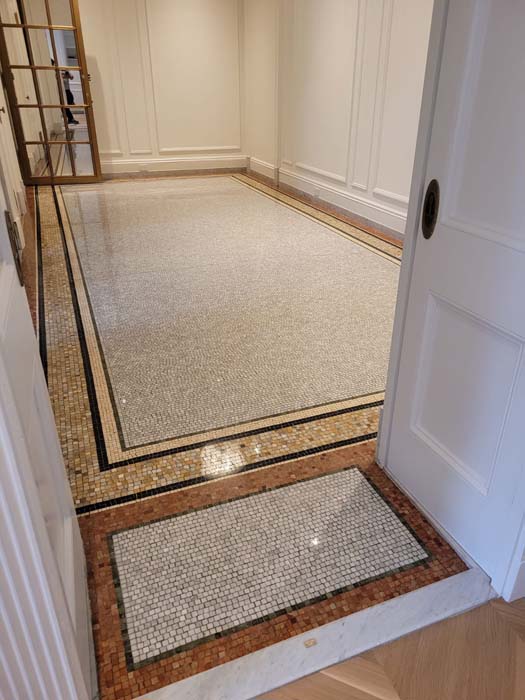
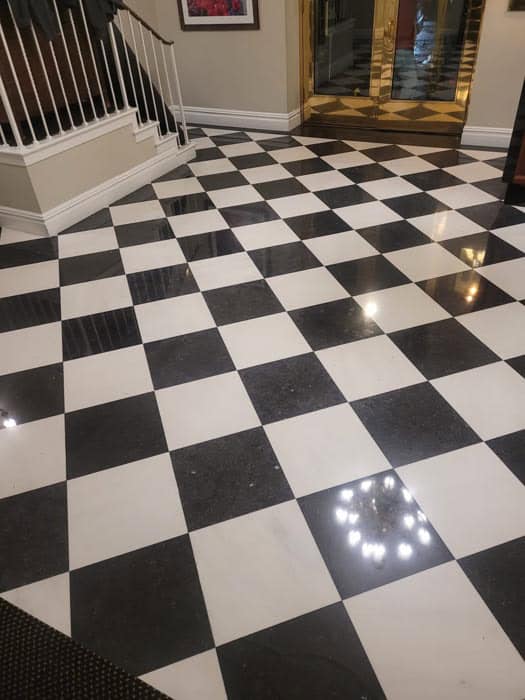
One thing worth knowing: not every hard floor should be stripped and waxed. VCT (vinyl composition tile), vinyl, and linoleum are the floors this process is designed for. Natural stone, marble, and properly maintained terrazzo — all common in New York County building lobbies and common areas — require entirely different treatment. Applying wax chemistry to those surfaces can cause real damage. If your building has a mix of floor types, which most New York County commercial properties do, you need a provider who knows the difference and treats each surface accordingly.
Industrial Floor Cleaning Equipment: What a Professional Setup Actually Looks Like
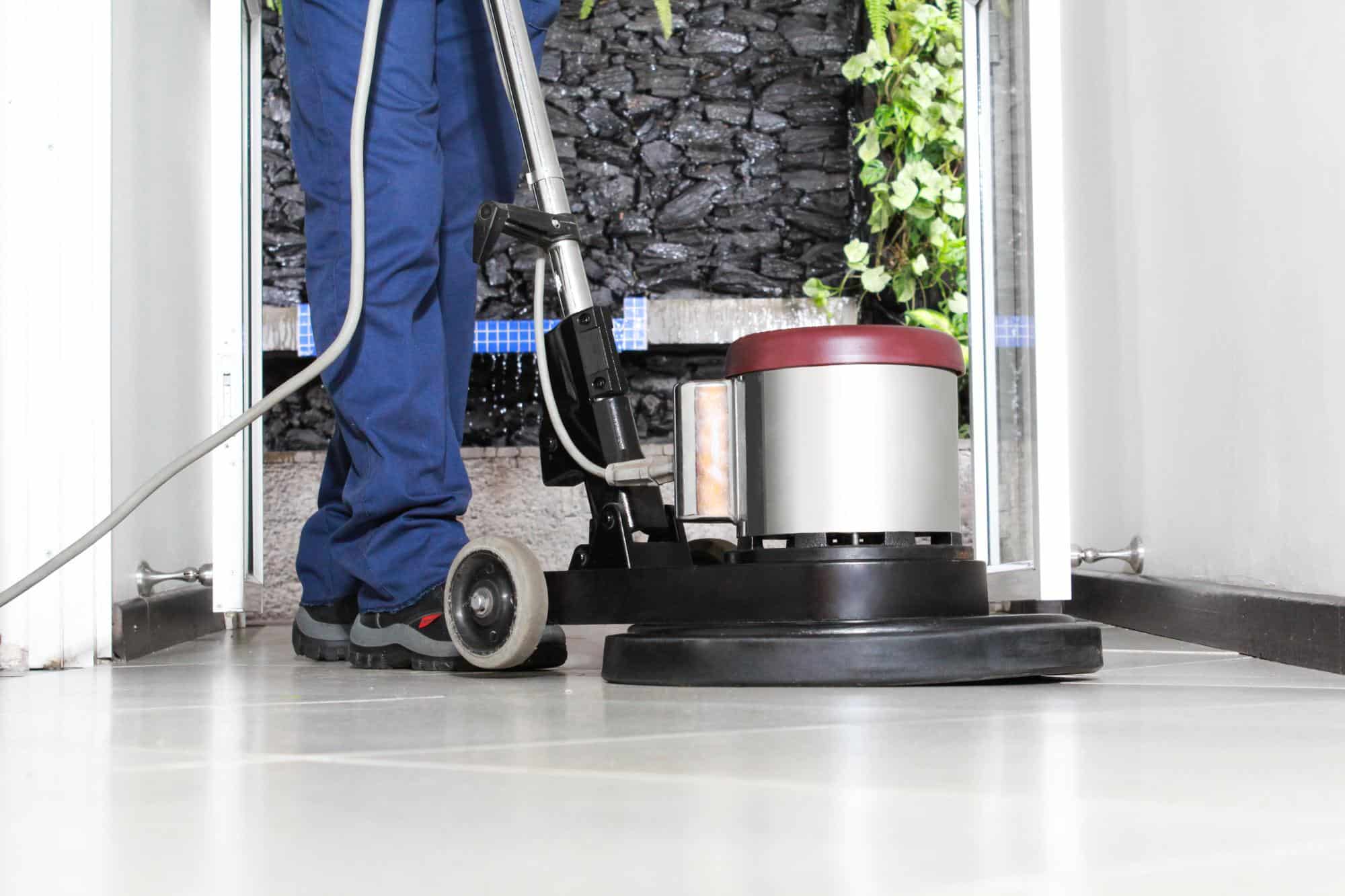
The equipment matters more than most clients realize. A proper commercial strip-and-wax job isn’t done with a mop and a bucket of stripper. It requires a rotary floor machine fitted with aggressive stripping pads — typically black or heavy-duty pads rated for stripping, not buffing — to agitate the chemical solution and mechanically lift the old finish off the surface. For larger commercial spaces, auto-scrubbers are used to cover ground efficiently while maintaining consistent pressure and chemical application.
After the stripper has been applied and allowed to dwell — typically five to ten minutes depending on the product and the condition of the floor — the machine works through the area in overlapping passes. But the machine can’t reach the edges. Corners, baseboards, and transition strips all have to be detailed by hand. Skipping that step is one of the most common shortcuts in the industry, and it’s exactly why so many commercial floors have that telltale dark perimeter buildup even after a recent service.
Once the old finish is lifted, the slurry — that gray-brown liquid mixture of dissolved wax, dirt, and chemical — gets extracted with a wet vacuum. Then comes a step that separates quality work from mediocre work: the neutralization rinse. The floor has to be thoroughly rinsed with a neutral cleaner to remove all traces of the chemical stripper. If residue is left behind, it interferes with the new finish and causes it to yellow almost immediately. A simple hand test tells you whether the rinse was thorough — if you run your palm across the dry floor and it comes up white, the floor wasn’t rinsed enough.
Only after the floor is fully dry does the new finish go down. For commercial VCT in a New York County building, three to five coats is standard, with each coat allowed to dry before the next is applied. Rushing that drying time — or using a dirty mop to apply the finish — seals grit and residue into the new wax, which defeats the entire purpose of stripping in the first place.
Floor Buffing as Part of a Long-Term Maintenance Plan
Once your floors have been properly stripped and refinished, the goal is to protect that investment as long as possible before the next full cycle. That’s where floor buffing comes in. Regular buffing — monthly to quarterly depending on traffic — keeps the finish looking sharp by polishing the surface and removing minor scuffs and scratches before they work their way deeper into the wax layers.
Think of it as the maintenance interval between major service cycles. A building that buffs consistently will extend the life of its floor finish significantly, which means fewer full strip-and-wax cycles per year and lower overall floor care costs. In New York County’s high-traffic commercial environment, that kind of proactive scheduling makes a real operational and financial difference.

How Often Should New York County Commercial Floors Be Stripped and Waxed?
The standard industry guidance — strip and wax every six to twelve months — is a reasonable baseline, but it was written with average commercial foot traffic in mind. New York County is not an average commercial environment.
A lobby in a Midtown office tower, a corridor in a mixed-use residential building on the Upper West Side, or a retail floor in a high-density commercial strip can process hundreds to thousands of foot traffic events per day. Add in what New York County winters bring: road salt, subway platform grit, and the general debris of a city that never fully slows down. Floor finish in those environments degrades faster than the standard schedule accounts for. Waiting twelve months between full strip-and-wax cycles in a high-traffic New York County building often means the last two or three months of that cycle are spent with a floor that’s visibly deteriorating.
A more realistic approach for New York County commercial spaces is to assess the floor’s condition quarterly. High-traffic areas — lobbies, main corridors, elevator vestibules — may need a full strip cycle every six months, with buffing in between. Moderate-traffic areas like private offices or secondary corridors can often go the full twelve months. The key is not following a rigid calendar but actually looking at the floor and understanding what you’re seeing.
Building managers and property managers who set up recurring maintenance programs — rather than calling for service only when the floors look bad — consistently get better results and spend less over time. By the time a floor looks bad to a tenant or visitor, it’s already past the point where a buff would have handled it. You’re into full strip territory, and you’ve also already made a visible impression on everyone who walked through.
Why Material Expertise Matters in New York County's Mixed-Surface Buildings
Here’s something that rarely comes up in conversations about commercial floor care, but matters enormously in New York County specifically: most commercial and luxury residential buildings don’t have just one floor type. A typical Class A office building or co-op might have a marble or terrazzo lobby, stone tile in the elevator vestibule, and VCT or vinyl in the service corridors and back-of-house areas. Each of those surfaces has completely different care requirements.
General commercial cleaning companies strip and wax VCT without issue. But when they encounter marble or terrazzo — which is common in New York County’s architectural stock — they either skip those surfaces entirely or, worse, apply the same chemistry they use on VCT. Wax doesn’t belong on marble. It doesn’t belong on polished terrazzo either. Properly maintained stone floors develop their finish through diamond polishing and sealing, not through wax coatings. Marble Polishing is appropriate for restoring and maintaining marble surfaces, while [Terrazzo Floor Restoration] addresses the specialized care required for terrazzo. Applying a floor finish product to those surfaces can cloud the stone, interfere with future polishing, and cause damage that takes real restoration work to undo.
We work across all of those surface types. Our background is in natural stone and hard surface restoration — marble, terrazzo, granite, tile, and metal — which means we understand what each surface needs and what it can’t tolerate. When we take on a commercial floor care project in New York County, we’re not applying a one-size-fits-all approach. We’re looking at what’s actually in front of us and treating it accordingly. That’s a meaningful difference from a general janitorial company, and it’s particularly relevant for building managers overseeing properties where a marble lobby sits right next to a VCT service corridor.
We’ve worked on commercial projects across New York County, including a six-story building with 40-year-old floors that needed full restoration — not just maintenance. The client noted the results were better than they expected. That kind of work requires more than a stripping machine and a bucket of wax. It requires knowing what you’re looking at and having the experience to handle it properly.
Getting Floor Stripping and Waxing Right in New York County
Floor stripping and waxing isn’t complicated in concept, but it’s easy to get wrong — and when it’s done wrong, the evidence shows up fast. Yellowing, premature finish failure, edge buildup, and floors that look worse after service than before are all signs of a job that skipped steps or used the wrong approach for the surface type.
For commercial buildings in New York County, the stakes are higher than in most markets. Foot traffic is heavier, winters are harder on floor finishes, and the building stock includes premium surfaces that require real material knowledge, not just cleaning equipment.
If your floors are due for a full strip-and-wax cycle — or if you’re not sure where they stand — we offer free estimates and work around your building’s schedule. Reach out to Diamond Stone Restorations Corp. to get a clear picture of what your floors actually need.