Summary:
If you’ve been staring at dull, scratched terrazzo floors and wondering whether they can actually be fixed — or whether someone’s just going to wax over the problem and call it done — you’re asking exactly the right question. The honest answer is that terrazzo restoration and terrazzo polishing are not the same thing, and confusing the two is how people end up disappointed and out of pocket. This page walks you through what real terrazzo restoration involves, what each stage actually does, and what to expect from the process — so you can make a confident decision before anyone sets foot in your building.
What Is Terrazzo Restoration, and How Is It Different from Polishing?
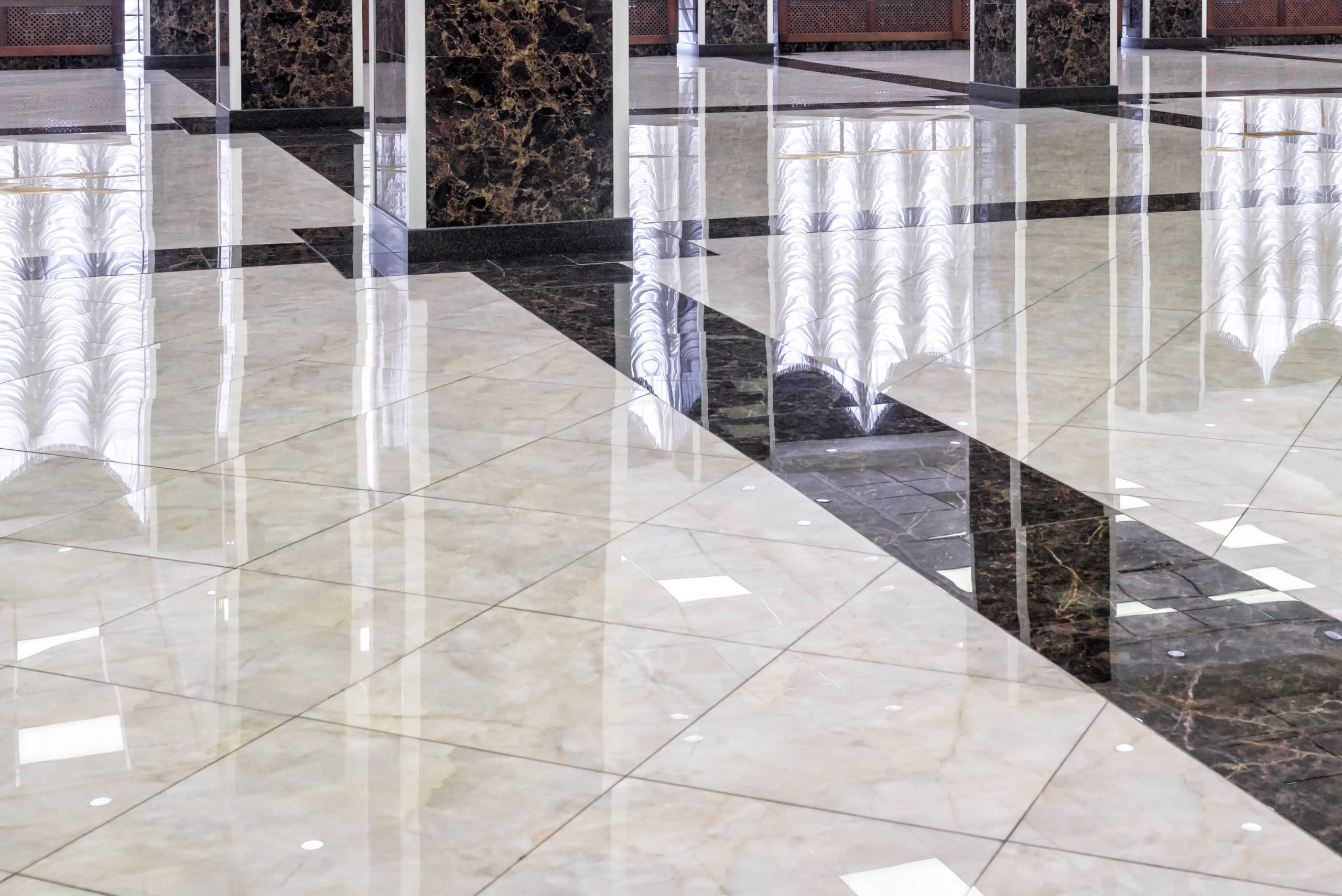
Terrazzo restoration is a multi-stage professional process that removes the damaged surface layer of a floor, repairs structural imperfections, and rebuilds the finish from the ground up using diamond abrasives and penetrating sealers. It is not a surface treatment. It is not buffing. And it is not the same as polishing, refinishing, or refurbishing — even though those words often get used interchangeably by companies that are offering something much less thorough.
Polishing is one stage within a full restoration. It improves the surface sheen but doesn’t remove deep scratches, level an uneven floor, or address chips and voids. If a company quotes you “terrazzo polishing” as the whole job, you’re likely getting a temporary improvement that fades within months. Restoration, done properly, produces results that last years.
Terrazzo Refinishing: What It Means and Where It Fits
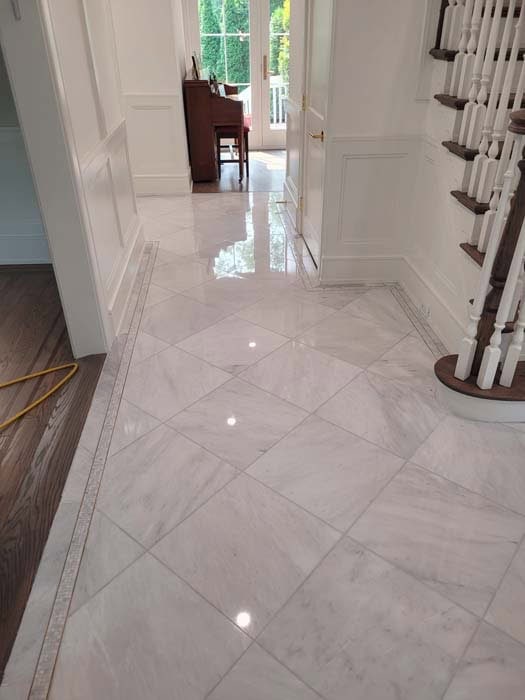
Terrazzo refinishing refers specifically to the surface layer renewal stage of the process — the phase where the old, damaged surface is mechanically ground away and the fresh material underneath is exposed and brought to a finished state. It’s one component of full terrazzo restoration, not a separate or lesser service. When a company says they offer “terrazzo refinishing,” they should mean they’re grinding down the surface with diamond abrasives and polishing what’s revealed. If they mean they’re applying a coating or finish product on top of the existing surface, that’s not refinishing — that’s waxing, and it’s the wrong approach.
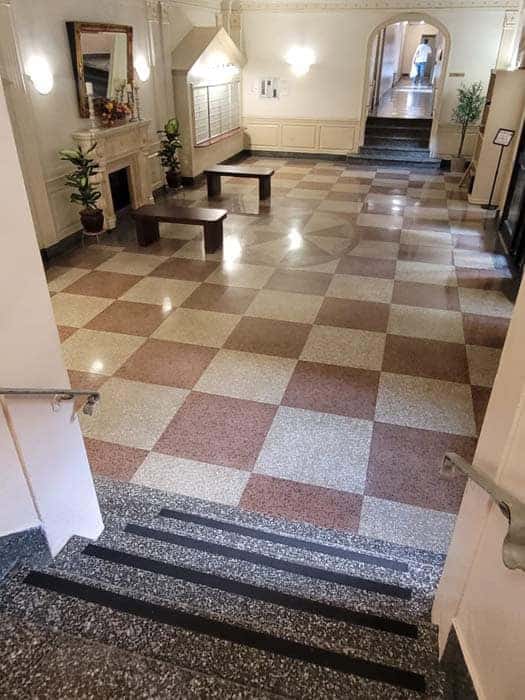
Here’s why that distinction matters. Terrazzo floors in New York County’s pre-war buildings — the lobbies on the Upper West Side, the hallways in Tribeca co-ops, the stairwells in mid-century apartment buildings throughout Manhattan — have often been coated with layers of wax and floor finish over decades. Those coatings yellow, scuff, and trap dirt. They make the floor look worse over time, not better. When we refinish terrazzo correctly, we’re removing all of that, getting back to the actual stone and aggregate surface, and polishing it to whatever sheen level you want — from a low-gloss satin finish to a high-gloss mirror finish.
The equipment involved in this stage is not a rental machine. Planetary grinding systems used in professional terrazzo work are heavy, specialized pieces of equipment that require trained operators. Using the wrong grit sequence or skipping stages doesn’t just produce a worse result — it can damage the floor further, creating unevenness that becomes more visible once the surface is polished. This is why the refinishing stage, done right, takes time and expertise. Shortcuts show.
Refurbishing Terrazzo Floors: The Cosmetic Renewal Stage Explained
Refurbishing is the stage that most people picture when they imagine terrazzo restoration — the visible transformation from a dull, chipped, stained floor to one that looks like it was just installed. But refurbishing doesn’t happen in isolation. It’s the cosmetic renewal phase that comes after the structural repair work is done, and it only produces lasting results when the earlier stages have been completed properly.
In practice, refurbishing terrazzo floors involves filling chips, cracks, and voids with color-matched material — a blend of marble chips and concrete tinted to match the original aggregate — so the repaired areas disappear into the surrounding pattern. It also includes addressing surface stains, removing old wax or coating buildup, and preparing the floor for progressive diamond polishing. Nail holes from old carpet tack strips, hairline cracks from building settlement, and chips from decades of foot traffic all get addressed at this stage.
For property owners in New York County, this part of the process is often where the real surprise happens. Terrazzo floors in Manhattan’s older buildings were installed during the material’s peak era — the 1920s through the 1970s — and many of them have never been professionally restored. They’ve been waxed, coated, and eventually covered with carpet or vinyl. When those coverings come off, what’s underneath is often structurally sound but visually rough. Refurbishing brings those floors back to a condition that reflects what they were originally, and in some cases, what they look like after restoration genuinely exceeds what the owner expected. We hear that often from clients who assumed the damage was too far gone.
The refurbishing stage also sets the floor up for sealing — the final protective step that determines how long the restored finish holds up against daily foot traffic, spills, and wear.
The Full Terrazzo Restoration Process, Stage by Stage
A complete terrazzo restoration moves through four distinct stages: assessment, grinding, polishing, and sealing. Each one builds on the last. Skipping or shortcutting any of them doesn’t just affect the final appearance — it affects how long that appearance lasts.
The assessment stage is where we evaluate the floor’s composition, condition, and specific damage. Different terrazzo types require different approaches. A 1950s Portland cement floor with marble chip aggregate behaves differently under diamond grinding than a more modern installation with recycled glass aggregate. Getting this wrong from the start produces inconsistent results that become obvious once the floor shines.
How Does the Diamond Grinding and Polishing Process Actually Work?
After the assessment, grinding begins. This is the stage that separates real terrazzo restoration from surface-level treatments. Diamond abrasives — starting at a coarse grit and moving progressively through finer grits — are used to mechanically remove the damaged surface layer of the terrazzo. This isn’t sanding. The equipment applies significant downward pressure across the floor surface, cutting through scratches, stains, and old coating buildup and exposing fresh, undamaged material underneath.
The progression through grit levels matters more than most people realize. Each pass refines the surface further, and the sequence has to be followed correctly. Moving too quickly to a fine grit without completing the coarser stages leaves micro-scratches in the surface that become visible under light once the floor is polished. This is why “three-step polishing” shortcuts — skipping the grinding stages and going straight to a polish — produce results that look decent for a few weeks and then revert. The clarity and reflectivity of a properly ground and polished terrazzo floor is visibly different from a floor that was only polished at the surface.
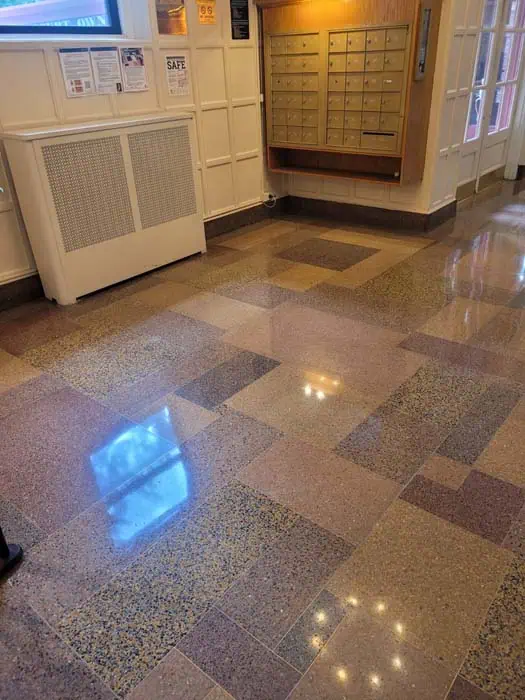
Once grinding is complete and all repairs have been made, polishing brings the floor to your chosen finish level. The same diamond tooling is used, but at progressively finer grits — from a honed matte finish up through a high-gloss mirror finish, depending on the building’s aesthetic and your preference. For commercial lobbies in Midtown or residential co-op buildings on the Upper East Side, the finish choice often reflects the building’s overall design — a high-polish finish in a formal lobby, a satin finish in a residential hallway that sees heavy daily traffic.
Throughout both the grinding and polishing stages, repairs are integrated into the process. Chips and voids that were filled earlier are ground flush with the surrounding surface so they disappear into the pattern. The floor is treated as a whole, not section by section, which is what produces a consistent, even finish across the entire space.
Why Terrazzo Restoration Makes Sense for New York County Buildings
In most markets, the restoration-versus-replacement decision comes down to cost and personal preference. In New York County, the calculation is different — and it tilts heavily toward restoration for reasons that are specific to Manhattan.
Start with building access. Replacing a terrazzo floor in a New York County co-op or condo building involves freight elevator scheduling, board approval, noise ordinance compliance, and coordination with neighboring units. The logistics alone add time and cost that don’t exist in a suburban renovation. Our floor restoration services are significantly less disruptive. We can phase commercial projects by floor or section, schedule around building hours, and complete the work with minimal impact on residents and tenants. A 6-story commercial building with 40-year-old floors is a project we’ve completed — and the client described our team as finishing quickly while working around the building’s schedule.
Then there’s the landmark and historic district factor. Large portions of New York County fall within NYC Landmarks Preservation Commission jurisdiction — neighborhoods like Greenwich Village, SoHo, Tribeca, the Upper West Side, and the Upper East Side all have significant landmarked building stock. In many of these buildings, replacing original terrazzo isn’t just expensive — it may require LPC review and approval. Restoration is often the only straightforward path forward, and it’s also the right one. These floors were installed to last, and with proper professional restoration, they can last another 75 years.
Finally, there’s the maintenance reality. Many New York County building managers are running a strip-and-wax cycle on their terrazzo floors — spending money annually on treatments that produce progressively worse results and mask the floor’s actual condition. Professional diamond restoration followed by a penetrating sealer eliminates that cycle. The restored surface requires nothing more than sweeping and damp mopping to maintain its finish, which matters in buildings where common area maintenance is an ongoing budget line. Our approach is designed with exactly this kind of long-term outcome in mind — not a cosmetic fix that needs to be redone in a year.
What to Expect When You Hire Diamond Stone Restorations Corp
The most important thing to take away from this is that terrazzo restoration is a process, not a single service. A company that offers to “polish your terrazzo” is describing one stage. We walk clients through assessment, grinding, repair, polishing, and sealing — and explain what each stage addresses and why.
If you’re in New York County and you’re looking at dull, scratched, or chipped terrazzo floors — whether in a residential apartment, a building lobby, or a commercial space — the floor is almost certainly restorable. The damage that looks severe at a glance is usually surface-level. And the results of a proper restoration, done with the right equipment and the right sequence, tend to exceed what most people expected was possible.
We work with residential and commercial clients throughout New York County and the broader New York area. If you want a straight answer about what your floors actually need — and an honest assessment of what restoration can realistically achieve — reach out for a free quote.