
Summary:
Most people contact us saying they need their marble polished. And sometimes, that’s exactly right. But a lot of the time, what they’re describing — scratches that won’t go away, dullness that cleaning doesn’t fix, surfaces that looked great for a week after the last service and then went right back to looking worn — points to something that polishing alone can’t solve.
The confusion is understandable. Grinding, honing, and polishing all involve machines, diamond tooling, and a technician on your floor. From the outside, they can look like variations of the same job. They’re not. Each one does something different, addresses a different level of damage, and produces a different result. Getting clear on the distinction is the first step toward actually fixing the problem.
Marble Grinding vs. Polishing: Understanding the Full Restoration Sequence
Marble grinding, honing, and polishing aren’t three separate services you choose between — they’re stages in a single progressive process, and each one builds directly on the last. Skipping a stage doesn’t save time. It just means the next stage can’t do its job properly, and the result shows it.
Grinding is the starting point when a surface has real damage: deep scratches, lippage (where one tile or slab sits higher than the one next to it), or years of accumulated wear that’s gone past the surface. Honing follows grinding and brings the stone to a smooth, consistent texture — either a matte or satin finish, depending on where you stop. Polishing comes last, developing the reflective clarity that makes marble look its best. Each stage prepares the surface for the one that follows. That sequence is the job.
What Does Marble Grinding Actually Do?
Grinding is the most aggressive stage of the process, and it’s the one most property owners don’t realize they need until a professional takes a look. It uses diamond-impregnated tooling at low grit levels — typically 50 grit or lower — to physically remove material from the surface of the stone. That sounds intense, but it’s controlled and precise. The goal is to cut down to a level below the damage, so the surface you’re working with from that point forward is clean, even, and structurally sound.
The most common reasons a surface needs grinding are lippage and deep scratches. Lippage is the unevenness you can feel when you run your hand across a marble floor and one edge sits higher than its neighbor. In New York County’s older buildings — think pre-war co-ops on Park Avenue or Fifth Avenue, buildings where the marble has been walked on for eighty or a hundred years — lippage is almost a given. It develops over time as the substrate shifts, as grout lines settle, and as heavy foot traffic wears certain areas unevenly. Grinding levels the surface so everything sits flush.
Deep scratches are the other primary driver. If a contractor renovated your space and dragged equipment across the floor, or if decades of use have carved visible lines into the stone, polishing over those scratches won’t make them disappear. It will make the surface shinier around them, which actually makes the damage more visible. Grinding removes the layer that contains the damage. That’s the only way to actually get rid of it.
We use a wet-sanding process during grinding, which keeps dust to a minimum and prevents heat from building up in the stone. Heat is a real concern with aggressive diamond tooling — it can cause micro-fractures in the marble that aren’t visible immediately but show up over time. Wet-sanding eliminates that risk and keeps the stone intact throughout the process.
After grinding, the surface looks rough and matte. That’s expected. It’s not finished — it’s prepared. Honing is what comes next.
Honing vs. Polishing Marble: What's the Difference?
This is where a lot of the confusion lives, and it’s worth taking a minute to be precise about it. Honing and polishing both use diamond abrasives, and both refine the surface of the stone — but they operate at different grit levels and produce fundamentally different results.
Honing uses mid-range grits, roughly 100 to 400, to smooth the scratch pattern left by grinding and bring the stone to a consistent, even texture. The result is a matte or satin finish — flat, soft, non-reflective. Honed marble is increasingly popular in New York County renovations and luxury apartments because it reads as more contemporary and it’s more forgiving in high-traffic areas. It doesn’t show footprints or water marks the way a polished surface does. The tradeoff is that it’s more porous and needs to be sealed properly to resist staining.
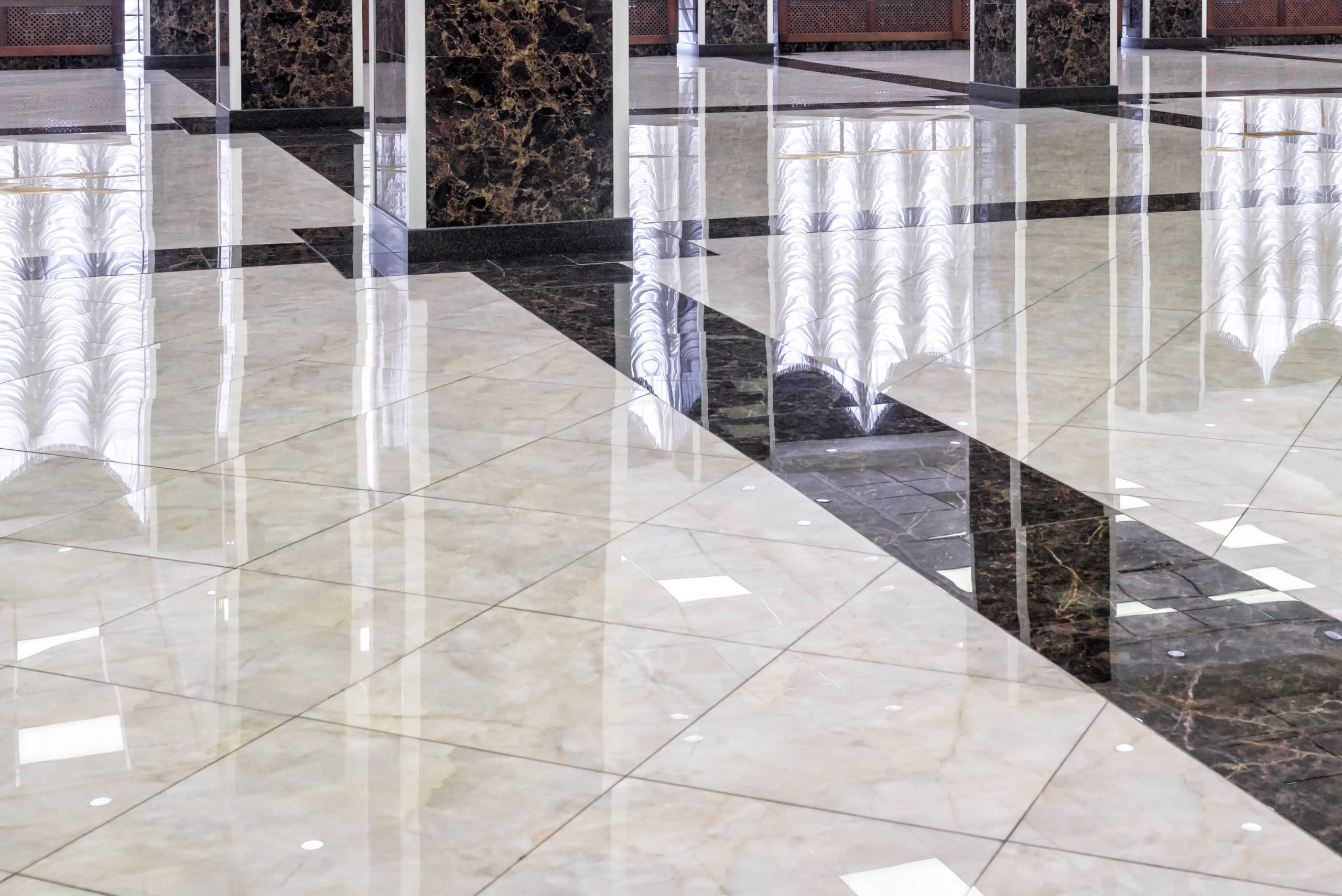
Polishing continues the diamond progression through finer grits — 800, 1500, 3000 and beyond — until the surface develops a mirror-like reflective quality. That gloss comes from the stone itself, not from a coating applied on top. When you see a marble lobby floor that looks like you could see your reflection in it, that’s a polished finish achieved through a proper diamond sequence, not a wax or a chemical treatment.
Here’s the practical point: you can’t polish your way to a honed finish, and you can’t hone a surface that needed grinding first and expect the result to hold. The stages matter because each one addresses a different depth of the stone. Honing physically removes material — it takes the damaged layer with it. Polishing refines what honing leaves behind. If you try to polish a surface with deep scratches or lippage, you’re putting a high-gloss finish over damage that’s still there. It looks good for a few days. Then the scratches catch the light again and you’re back where you started.
For property managers overseeing common areas in New York County co-ops or condos, this distinction is especially relevant. Building boards often require restoration — not replacement — of original architectural stone. Knowing whether that lobby floor needs grinding, honing, or a full sequence from start to finish is the difference between a restoration that lasts years and one that needs to be redone in six months.
Marble Polishing and Sealing: Why the Last Step Is the One Most People Skip
Polishing is the stage that gets the most attention because it’s the most visible transformation. A properly polished marble surface is genuinely striking — the kind of finish that makes a pre-war lobby or a Tribeca kitchen feel like it was just installed. But polishing without sealing is an incomplete job, and it’s one of the most common reasons restored marble starts looking worn again within weeks.
Marble is porous. After grinding and polishing, the surface is clean and open — which means it’s also immediately vulnerable to staining and etching from acids, liquids, and everyday use. Sealing closes those pores and creates a protective barrier that lets the polished finish last the way it’s supposed to. It’s not a luxury add-on. It’s the step that makes everything before it worth doing.

What Is Etching on Marble and Can It Be Fixed?
Etching is one of the most misunderstood problems in marble care, and it’s worth explaining clearly because it affects nearly every marble surface in a kitchen or bathroom eventually. What looks like a stain — a dull, cloudy mark that won’t come off no matter how much you clean it — is often not a stain at all. It’s a chemical reaction.
Marble is calcium carbonate, and acids eat into it. Lemon juice, coffee, wine, vinegar-based cleaners, even some soaps — all of them can etch marble on contact. The acid dissolves a thin layer of the stone’s surface, leaving a dull, rough patch where the polished finish used to be. You can’t clean it away because it isn’t a substance sitting on top of the marble. It’s damage to the marble itself.
The fix depends on how deep the etching goes. Light etching — the kind from a single spill that wasn’t wiped up quickly — can often be addressed through honing and re-polishing the affected area. Deeper or more widespread etching, particularly on a surface that’s been neglected for years, typically requires grinding to get below the damaged layer before honing and polishing can produce a clean result.
In New York County apartments where marble countertops and bathroom floors see daily use, etching is nearly inevitable without proper sealing. That’s the connection between polishing and sealing that matters most in a residential context: a sealed surface still etches, but it etches more slowly and less severely, giving you time to address spills before they cause lasting damage. A surface that was polished but never sealed will show etch marks within days of normal use in a kitchen or bathroom.
This is also why we provide personalized maintenance guidance after every restoration. The right maintenance approach depends on your specific stone, your specific finish, and how the space is used. A honed marble floor in a high-traffic New York County lobby has different needs than a polished marble vanity in a private residence. There’s no single answer that applies to every situation.
Marble Stone Polish: When Polishing Alone Is the Right Call
Not every marble surface needs grinding. It’s worth being clear about that, because the goal here isn’t to convince you that your surface needs the most extensive treatment possible — it’s to help you understand what your surface actually needs so you can make an informed decision.
If your marble is structurally sound — no lippage, no deep scratches, no significant etching — and the surface just looks dull or has lost its reflective quality, polishing alone may be exactly the right treatment. This happens with surfaces that have been well-maintained over time but have gradually lost their finish through normal use, or with marble that was properly restored previously and just needs a refresh.
The way to tell the difference is by looking at what’s causing the dullness. Run your hand across the surface. If it feels smooth and even but just looks flat, that’s a surface that’s lost its polish — and re-polishing can bring it back without any grinding or honing. If you can feel scratches, if there are areas where the surface is uneven, or if the dullness is patchy and concentrated in high-traffic areas, those are signs that the problem goes deeper than the surface finish.
In commercial settings — hotel lobbies in Midtown, restaurant floors in the West Village, retail spaces in SoHo — marble surfaces often need a full sequence because the volume of foot traffic accelerates wear at every level. But in a private residence where a marble bathroom floor has been used carefully and cleaned regularly, a polish and seal might be the complete answer.
The honest approach is to assess the surface before recommending a treatment. That’s what we do with every free estimate — look at what’s actually there, determine the right starting point, and explain what the process will involve before any work begins. If polishing is all your surface needs, that’s what we’ll tell you. If it needs grinding first, we’ll explain why and show you what we’re seeing.
Our proprietary Safe Marble Solution is also available for post-restoration protection and ongoing maintenance, giving your surface an additional layer of defense between professional treatments.
Which Marble Restoration Process Does Your Surface Actually Need?
The short answer: it depends on what’s causing the problem, and the only way to know for certain is to look at the surface properly before making any decisions. Grinding addresses damage that goes below the surface — lippage, deep scratches, severe etching. Honing smooths and levels what grinding leaves behind. Polishing develops the finish. Sealing protects it. Each stage has a purpose, and the right combination depends entirely on the condition of your stone.
What we’ve found, working with properties across New York County, is that most surfaces that have been “polished” repeatedly without improvement actually needed grinding first. The polishing wasn’t the problem — the sequence was wrong from the start. Getting that diagnosis right at the beginning is what separates a restoration that lasts from one that frustrates.
If your marble isn’t looking the way it should and you’re not sure what it actually needs, Diamond Stone Restorations Corp offers free estimates with no obligation. Reach out, describe what you’re seeing, and we’ll take a look — no guesswork, no upselling, just an honest assessment of what your surface needs and what it will take to get it there.