
Summary:
You noticed the damage. Maybe it’s a chip on the corner of your granite, a dull foggy patch on your marble that won’t clean off, or a crack near the sink that keeps nagging at you. Whatever it is, you’re now trying to figure out whether this is fixable — and how. The problem is that most of what you’ll find online treats stone countertop repair like a one-size-fits-all fix. It isn’t. The method that works on granite will not work on marble, and what looks like a stain on marble is often something else entirely. Here’s what you actually need to know before making any decisions.
Why the Type of Stone Determines the Type of Repair
Stone is not a single material — it’s a category. Granite, marble, quartz, travertine, and terrazzo each behave differently under pressure, heat, acid, and abrasion. That means the repair approach has to match the material, not just the damage. A professional who treats all stone the same isn’t really a stone specialist.
The hardness of the stone matters enormously. Marble sits at a 3 to 4 on the Mohs hardness scale, which makes it relatively soft and highly reactive to acids. Granite sits at a 6 to 7, making it much harder and more resistant — but still vulnerable to chipping along edges and corners. Quartz is engineered, which means it behaves differently than natural stone and requires different adhesives and compounds altogether.
Understanding this upfront saves you from a costly mistake. It also helps you have a much more productive conversation with whoever you bring in to do the work.

How Granite Countertop Repair Actually Works
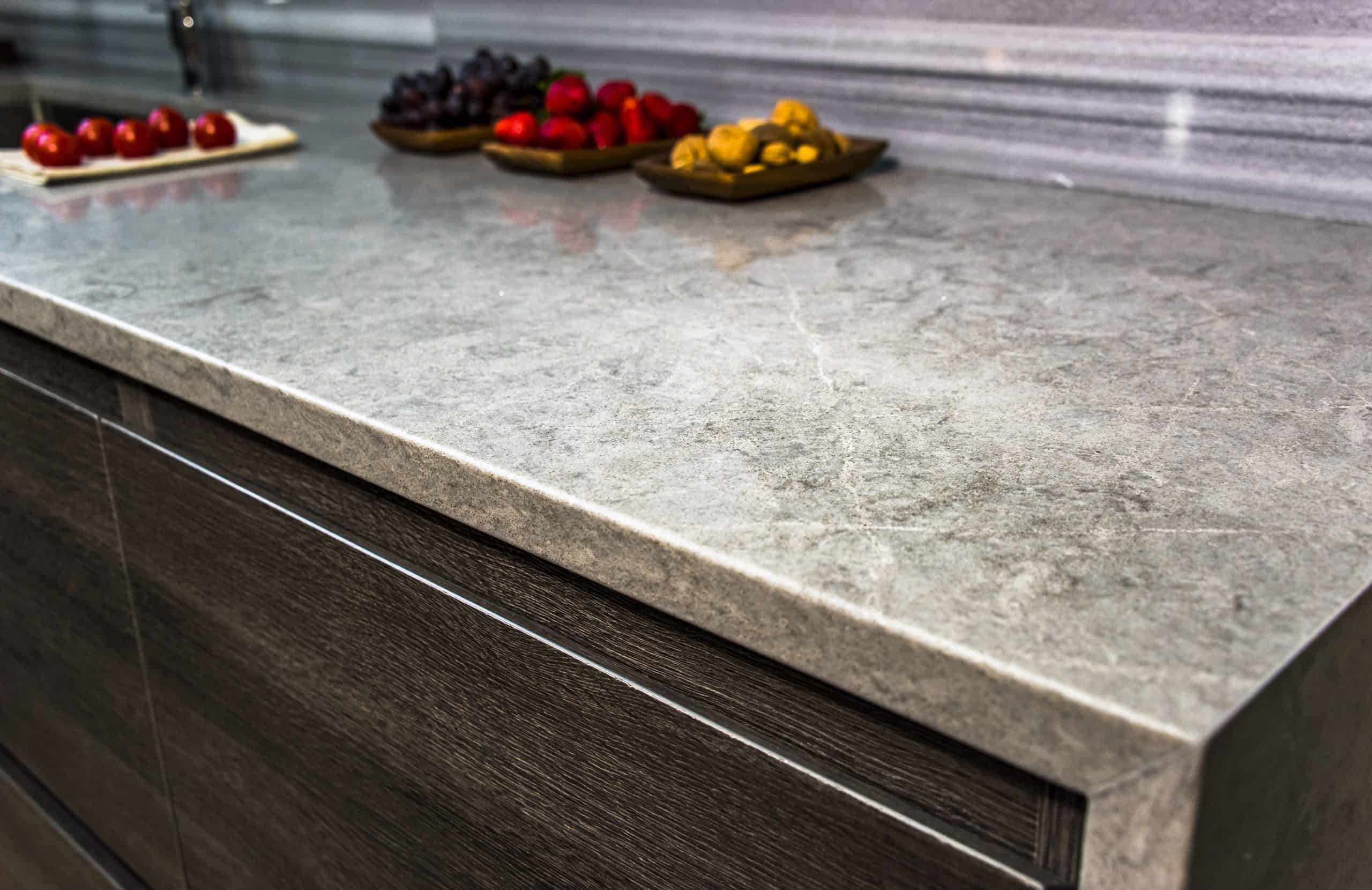
Granite is tough, but it chips. The most common damage shows up along the edges and corners — places where a heavy pan, a dropped appliance, or years of contact have taken their toll. Surface scratches are less common on granite because of its hardness, but they do happen with abrasive cleaners or rough contact over time.
For chips and small breaks, we use a color-matched epoxy or resin that’s worked into the void, cured — often with a UV light for a faster, harder bond — and then leveled and polished to blend with the surrounding surface. When it’s done well, the repair is nearly invisible. The key word there is “color-matched.” The epoxy has to be tinted to match your specific slab, which varies even within the same stone type. This is where DIY kits consistently fall short — they come with a generic filler that rarely matches, and the result looks patched rather than repaired.
For surface scratches on granite, the process involves a progressive sequence of diamond abrasives, starting coarser and working finer, followed by polishing to restore the sheen. This is not something you can replicate with sandpaper from a hardware store. The abrasive sequence has to be precise, and skipping steps leaves visible marks.
Cracks are a different conversation. A hairline crack that runs along the surface is typically cosmetic and can be stabilized and filled. A crack that runs through the full thickness of the slab — especially one near a sink or cooktop cutout — may be structural. In some cases, cracks in that area are caused by a rusted metal support rod expanding inside the stone. That requires a fundamentally different repair: removing the rod, rebuilding the area with epoxy, and re-polishing. Surface filling alone won’t hold. If you have a crack near a cutout that seems to be spreading, that’s worth getting assessed by someone who can actually evaluate the structure, not just the surface.
Marble Countertop Repair: Why Cleaning Won't Fix the Problem
Marble is where most homeowners run into trouble — not because the damage is worse, but because it’s misunderstood. The most common complaint we hear from New York County homeowners is some version of: “There are these dull, foggy spots on my marble and no matter what I clean them with, they won’t go away.” That’s not a stain. That’s etching.
Etching happens when an acidic substance — lemon juice, wine, vinegar, coffee, or even many common cleaning products — comes into contact with marble’s calcium carbonate surface and causes a chemical reaction. The acid literally eats into the stone, leaving a dull, matte mark that looks like a water stain but behaves nothing like one. You can scrub it for hours and nothing will change, because the damage is in the stone itself, not on top of it.
The fix for etching is mechanical, not chemical. It requires honing — a controlled abrasion process that removes a very fine layer of the damaged surface — followed by re-polishing to bring the sheen back. The depth of the etch determines how aggressive the honing needs to be. Light etching from a single spill is usually a straightforward fix. Deep etching from years of acidic exposure takes more work but is still restorable in most cases.
Chips on marble follow a similar repair logic to granite — color-matched filler, cured and polished — but the softer nature of the stone means the surface around the chip is more likely to have micro-scratches that need to be addressed at the same time. Marble also scratches more easily than granite, so we often hone the broader surface to create a consistent finish rather than just addressing the chip in isolation.
One more thing worth knowing: after any marble repair, sealing is essential. Marble is porous, and without a penetrating sealer applied after restoration, it’s vulnerable to staining and future etching almost immediately. A proper restoration job includes this step — if someone quotes you a marble repair without mentioning sealing, ask about it.
Repair vs. Replace: How to Make the Right Call for Your Countertop
The moment most people start searching for countertop repair, they’re already doing mental math on whether it’s worth it. You’ve probably already gotten one quote for new countertops and felt the sticker shock. In New York County, a full countertop replacement — accounting for materials, labor, building logistics like elevator reservations and freight access, and disposal — can run $8,000 to $15,000 or more. Professional restoration typically runs $3 to $8 per square foot, depending on the damage and stone type.
That math alone makes restoration worth exploring. But the more useful question is: what can actually be restored, and what can’t?
The honest answer is that most countertop damage that looks severe is restorable. Deep etching, significant staining, worn surfaces, chips along edges — these are regular repairs for our experienced stone restoration team. The exceptions are true structural failures: a slab that has broken in half, stone that has been so aggressively damaged that the structural integrity is gone, or situations where the underlying support has failed. Those cases are genuinely rare.

When DIY Stone Countertop Repair Makes Things Worse
It’s worth talking about DIY repair honestly, because the temptation is real. The kits are cheap, the videos make it look manageable, and the promise of a quick fix is appealing. For some very minor surface scratches on granite, a careful DIY approach can work. For almost everything else, it tends to create a bigger problem than the original damage.
The core issue is that stone doesn’t respond to materials the way wood, metal, or plastic does. Generic adhesives — the kind most repair kits include — soften when exposed to moisture, heat, or the weight of everyday use. A chip repair done with the wrong filler looks fine for a few weeks and then starts to lift, discolor, or crumble. Now you have the original chip plus a failed repair, and a professional has to undo both before starting the actual fix.
The other common mistake is using the wrong abrasive. Homeowners trying to buff out a scratch on marble often reach for fine sandpaper or a polishing pad. Without knowing the correct sequence — starting coarser and working progressively finer — they create new scratches in the process of trying to remove the original one. On marble especially, which scratches easily, this can turn a small problem into a large one quickly.
If you don’t know that dull spots on marble are acid damage rather than surface buildup, you might spend weeks trying different cleaning products, none of which will do anything except potentially make the surface more porous and vulnerable. The sooner you get an accurate diagnosis, the less time and money you lose going in the wrong direction.
For anything beyond a very light surface scratch on a hard stone like granite, professional assessment is worth it — if only to confirm what you’re actually dealing with before you touch it.
What Stone Countertop Repair Looks Like for New York County Homeowners
New York County presents a specific set of conditions that affect both how stone surfaces wear and what restoration looks like in practice. Pre-war buildings across the Upper West Side, Upper East Side, Harlem, and beyond often contain original marble — bathroom vanities, fireplace surrounds, kitchen surfaces — that has never been properly restored. Decades of acidic cleaning products, hard water, and daily use have left surfaces that look permanently damaged but are frequently restorable with the right approach.
The city’s climate adds to the wear. Hot, humid summers and cold, dry winters put stress on stone surfaces, particularly in bathrooms where steam and moisture are constant. Marble and travertine in these environments tend to show etching and surface wear faster than in drier climates. Regular maintenance — including professional honing and sealing every few years — extends the life of the stone significantly and keeps restoration costs manageable over time.
There’s also the practical reality of working in New York County buildings. Many co-ops and condo boards have strict rules about renovation work — noise restrictions, freight elevator scheduling, requirements for dust containment. Full countertop replacement involves demolition, new material delivery, and installation noise that can be genuinely difficult to coordinate in a dense residential building. Restoration is quieter, faster, and far less disruptive. Most countertop repairs are completed in a single day, and surfaces are usable again within 24 to 48 hours. In many buildings, restoration isn’t just the more cost-effective option — it’s the more practical one.
For property managers handling unit turnovers in New York County, stone restoration is also a meaningful tool. Rather than replacing countertops between tenants, professional restoration brings surfaces back to near-new condition at a fraction of the cost — and without the scheduling complexity of a full installation. We work with both residential homeowners and commercial and property management clients throughout New York County, and the approach is the same in either case: accurate diagnosis first, then the right repair for the specific stone and the specific damage.
Getting Stone Countertop Repair Right the First Time
The single most important thing to take away from all of this is that the method has to match the material. A repair that works on granite can damage marble. A cleaning routine that makes sense for quartz can accelerate etching on travertine. And a DIY fix that looks fine on day one can create a bigger problem by month two.
Most countertop damage — chips, scratches, etching, staining, worn surfaces — is restorable when it’s diagnosed correctly and handled by someone who actually knows the difference between stone types. The cases where replacement is truly necessary are far less common than most homeowners assume.
If you’re in New York County and you’re trying to figure out what you’re dealing with, the best first step is an honest assessment from someone who will tell you what the damage actually is — not what’s most profitable to fix. That’s how we approach every job at Diamond Stone Restorations Corp, and it’s why our customers consistently tell us the results exceeded what they expected.