
Summary:
Grout cleaning sounds simple enough. You scrub, you rinse, you move on. But if you’ve ever spent an hour on your hands and knees only to stand up and realize it barely looks different — or worse, noticed your marble tile looking dull and hazy afterward — you already know there’s more to it than effort. The problem isn’t always how hard you’re cleaning. Sometimes it’s what you’re cleaning with, and on the wrong surface, the wrong product doesn’t just fail to help. It causes damage that’s genuinely difficult to undo. Here’s what’s actually going on, and what professional tile grout cleaning can do that DIY methods can’t.
Tile Grout Cleaning: Why Most DIY Methods Fall Short
Grout is porous. That’s the root of the problem. It absorbs everything — water, soap residue, cooking grease, foot traffic grime — and most of it settles deep in the material, well below the surface layer your scrub brush can actually reach.
When you clean grout yourself, you’re mostly working on the top. The embedded contamination stays put, and within a few weeks, the grout looks just as dark as before. That frustrating cycle isn’t a reflection of your effort. It’s a physics problem.
Consumer products and manual scrubbing simply don’t have the mechanical force to pull contaminants out from inside the grout. Professional tile grout cleaning systems use controlled heat and pressure to loosen what’s trapped below the surface, then immediately extract it — rather than pushing it around or leaving it to resettle. The result looks different because it actually is different.
What Happens When You Use the Wrong Cleaner on Natural Stone Tile
This is where DIY grout cleaning can go from frustrating to genuinely costly — especially in New York County, NY, where pre-war buildings are filled with original marble floors, marble bathroom surrounds, and travertine tile that’s been in place for decades.
The products most people reach for — things like Tilex, CLR, Kaboom, or even plain white vinegar — are acidic. That’s what makes them effective on ceramic tile and porcelain. Acid cuts through soap scum and hard water deposits efficiently. But marble, limestone, and travertine are calcium-based stones, and acid reacts with calcium on contact.
The result isn’t just a failure to clean. It’s a chemical reaction that etches the stone surface, leaving it dull, hazy, or visibly damaged along the grout lines — often in a way that looks like staining but is actually structural.
Vinegar is one of the most common culprits. It has a pH of around 2 to 3, and despite its reputation as a gentle, natural cleaner, it reacts immediately with natural stone. CLR is arguably worse — the product name literally stands for Calcium, Lime, Rust, which tells you exactly what it’s designed to dissolve. Marble and limestone are made of calcium. Using CLR on a marble bathroom is a bit like using paint stripper on a hardwood floor.
The damage isn’t always obvious at first. You might think the surface looks cleaner right after, because the acid does remove surface buildup. But within days, you’ll notice the stone looks flatter, less reflective, or discolored along the grout lines. That’s etching — and it doesn’t buff out with more scrubbing.
Restoring etched natural stone requires professional grinding and polishing to remove the damaged layer and bring back the surface finish. We’ve seen this more times than we can count in New York County apartments, particularly in older buildings where the original marble is irreplaceable.
If you have ceramic or porcelain tile, many off-the-shelf cleaners work fine. But if your tile is marble, travertine, limestone, or any other natural stone, the standard advice — “use the best tile and grout cleaner you can find” — can lead you straight into a repair situation. The only products that are genuinely safe for natural stone are pH-neutral, acid-free formulas specifically designed for stone surfaces.
Professional Equipment vs. DIY Grout Cleaning Results
Even when you’re using the right product for your tile type, there’s a ceiling on what DIY methods can achieve — and it comes down to equipment.
Professional tile cleaning systems use high-temperature hot water extraction combined with commercial-grade cleaning agents to penetrate grout at depth. The heat loosens contaminants that have bonded to the interior of the grout over months or years. The extraction then pulls all of that material out immediately, before it can resettle on the surface. This is a fundamentally different process from applying a cleaner, scrubbing, and rinsing — which, at best, cleans the top layer and redistributes the rest.
The difference shows up visually in a way that’s hard to overstate. Grout that looked permanently stained often comes back to something close to its original color after professional cleaning. Surfaces that seemed like they needed regrouting often don’t.
We’ve worked on New York County buildings — lobbies, restaurant floors, residential bathrooms — where the owners had been told the grout was too far gone to save, and professional cleaning proved otherwise. There’s also the matter of consistency. DIY cleaning tends to produce uneven results. High-traffic areas stay darker. Corners and edges look different from the center of the floor.
Professional equipment covers the surface evenly, applying the same pressure and temperature throughout, which means the finished result looks uniform rather than patchy.
After cleaning, professional grout sealing is what makes those results last. Grout is essentially a form of concrete — it will absorb whatever comes into contact with it unless it’s properly sealed. A quality sealant applied after a deep clean creates a barrier that keeps the grout from staining as quickly, and makes routine maintenance much easier going forward.
For high-traffic areas, sealing every six to twelve months is a reasonable maintenance schedule. For lower-traffic spaces, once every year to eighteen months is typically sufficient.
Professional Tile Cleaning in New York County, NY: What the Process Looks Like
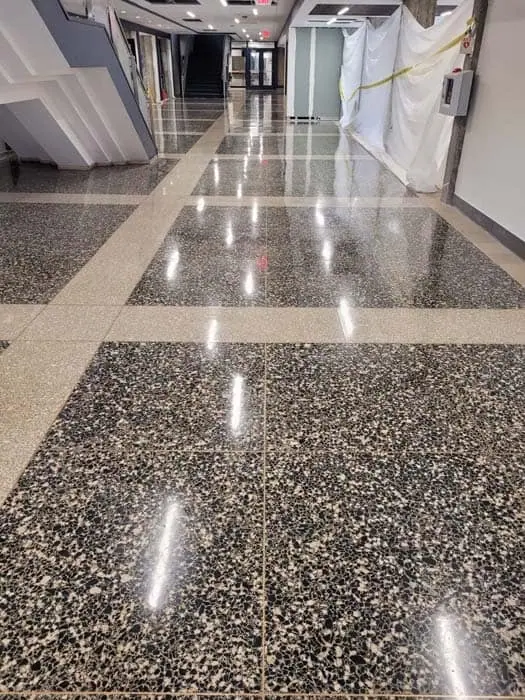
New York County has some specific characteristics that make professional tile cleaning more relevant here than in most markets. The housing stock skews heavily toward pre-war co-ops and condominiums, many of which have original marble floors, terrazzo lobbies, and ceramic tile in bathrooms and kitchens that are 80 to 100 years old. These surfaces require care that accounts for the material — not a one-size-fits-all approach.
On the commercial side, the density of hotels, restaurants, and office buildings in New York County means tile and grout maintenance is an ongoing operational need, not a one-time project. The expectations are different here. A restaurant in Midtown or a luxury co-op lobby on the Upper West Side can’t afford surfaces that look neglected, and the foot traffic those spaces absorb accelerates wear and staining significantly.
How We Approach Natural Stone and Tile Grout Cleaning in New York County
At Diamond Stone Restorations Corp, we work with all the major natural stone types — marble, granite, terrazzo, limestone, travertine, and slate — and each one requires a different approach. The cleaning chemistry, the equipment settings, the pressure levels, the sealants — none of it is interchangeable. What works on terrazzo can damage marble. What’s appropriate for a polished granite floor is different from what you’d use on a honed limestone surface.
That material-specific approach is especially important in New York County’s older buildings. We’ve worked on pre-war marble floors in residential buildings, terrazzo lobbies in mid-century co-ops, and large-scale commercial projects — including ongoing maintenance for a Times Square restaurant that has involved more than 55,000 pounds of marble since 2015. The scale varies, but the principle doesn’t: the right technique for the material, applied consistently, produces results that last.
For residential clients — whether you own a condo in Tribeca or manage a co-op building on the Upper East Side — the process typically starts with an assessment of the surface type and condition. From there, we match the cleaning method and products to what the material actually needs. We use pH-neutral, stone-safe formulas on natural stone surfaces, professional extraction equipment for deep grout cleaning, and quality sealants that protect the surface after the work is done.
The goal is always to restore what’s there rather than replace it — which, beyond the cost savings, means preserving original materials that often can’t be replicated. We also work with property managers and building superintendents who need reliable, scheduled maintenance across common areas, hallways, and lobby floors. New York County buildings have high standards, and keeping tile and grout in good condition is part of maintaining property value and the overall appearance of the building.
When to Call a Professional — and When DIY Is Fine
Not every grout cleaning situation requires professional help. If you have ceramic or porcelain tile in good condition, light surface staining, and you’re using the right pH-neutral product for your tile type, regular DIY maintenance is perfectly reasonable. A quick clean every few weeks keeps buildup from accumulating, and that’s a manageable task for most homeowners.
The calculus changes under a few specific conditions. If your tile is natural stone — marble, travertine, limestone, slate — DIY cleaning carries real risk unless you’re certain the product you’re using is acid-free and pH-neutral. One wrong application of an acidic cleaner can etch the surface in a way that requires professional restoration to correct. The cost of fixing that damage is substantially higher than the cost of professional cleaning in the first place.
If your grout is heavily stained, discolored, or showing signs of mold that surface scrubbing hasn’t resolved, professional equipment is likely the only thing that will actually make a difference. The contamination is below the surface layer, and no consumer product or scrub brush is going to reach it. Similarly, if you’ve already tried multiple DIY approaches and the grout still looks dark or uneven, that’s a strong indicator that the problem is deeper than surface cleaning can address.
There’s also the situation we see fairly often in New York County: someone has used the wrong product on a marble or travertine surface and is now dealing with etching or discoloration along the grout lines. If that’s where you are, the first step is stopping any further DIY attempts — more cleaning with the wrong product will make it worse.
Professional assessment can determine whether the damage is in the surface finish (which can be restored through grinding and polishing) or deeper, and what the realistic options are. For most New York County homeowners and building managers, a professional deep clean once a year to once every eighteen months is a practical maintenance schedule — enough to keep grout in genuinely good condition without the surfaces deteriorating between visits.
Grout Cleaning That Actually Works — What to Do Next
The short version: DIY grout cleaning works fine for routine surface maintenance on ceramic and porcelain tile. For natural stone, or for grout that’s been stained deep enough that scrubbing hasn’t touched it, professional cleaning produces results that DIY methods physically can’t replicate — and using the wrong product on marble or travertine can turn a cleaning project into a restoration project.
If you’re in New York County and you’re not sure what you’re dealing with — whether the surface is natural stone, what’s actually causing the discoloration, or whether the damage that’s already there can be fixed — the most useful thing you can do is get an honest assessment before trying anything else.
Diamond Stone Restorations Corp offers free estimates with no pressure. If the problem is something you can handle yourself, we’ll tell you. If it’s something we can fix, we’ll show you exactly what that looks like. Reach out to our team to get started.