
Summary:
If you sit on a co-op board in New York County, you already know the lobby is the first thing prospective buyers see — and the first thing shareholders complain about when it looks bad. What most boards don’t have is a clear, practical plan for keeping marble and terrazzo floors in shape before they become a problem. Not a vague “schedule regular maintenance” suggestion. An actual framework: how often, how much, what to look for in a contractor, and how to get it into the budget without a fight. That’s exactly what this guide covers.
How to Budget for Marble Tile Polish in a New York County Co-op Building
Most co-op boards in New York County approach stone floor maintenance the same way — reactively. The lobby starts looking dull, a shareholder says something at the annual meeting, and suddenly the board is scrambling to find a contractor, get an estimate, and figure out how to pay for it without a special assessment. That cycle is more expensive than it looks, and it’s entirely avoidable.
The smarter approach is to treat marble tile polish the same way you treat any other building maintenance line item: with a schedule, a cost estimate, and a plan that gets approved in the annual operating budget before the floor looks bad. Once you have those three things, stone maintenance stops being a crisis and starts being a routine.

Stone Polishing Services: What to Look for in a New York County Contractor
Not every stone polishing service is equipped to work in an occupied New York County co-op building. That distinction matters more than most boards realize until something goes wrong.
A contractor doing residential bathroom vanities operates in a completely different environment than one managing a six-story building lobby with shareholder traffic, elevator reservations, noise restrictions, and a co-op board alteration agreement to sign. The logistics alone — dust containment, scheduling around building rules, coordinating with the superintendent — require experience that a generalist cleaning company simply doesn’t have.
When you’re evaluating stone polishing services for your building, the questions that actually matter are: Have you worked in occupied co-op buildings before? Can you provide references from property managers or building supers? What’s your dust containment protocol? Do you carry the liability insurance our board requires? In New York County, most co-op boards require contractors to carry between $2 million and $5 million in liability coverage. That’s a baseline, not a negotiation point — and any reputable contractor should be able to provide documentation before the first walkthrough.
Beyond insurance, look for a company that assesses the surface before quoting. Marble, terrazzo, limestone, and granite each require different abrasive sequences and treatments. A contractor who gives you a price without looking at the floor first is either guessing or cutting corners. The right provider will tell you what condition the surface is actually in, what method is appropriate, and what the realistic outcome looks like — before any work begins.
One more thing worth asking about: how do they handle scheduling in an occupied building? A contractor who can only work Monday mornings or needs unrestricted elevator access for three days straight is going to create friction with your residents. Flexibility matters. So does the ability to work efficiently — most professional marble polishing jobs in a building common area can be completed in a single workday, which minimizes disruption significantly.
How Often Does Marble Actually Need to Be Polished in a High-Traffic Building?
This is the question boards almost never get a straight answer to — and the vagueness is part of what keeps stone maintenance off the operating budget year after year.
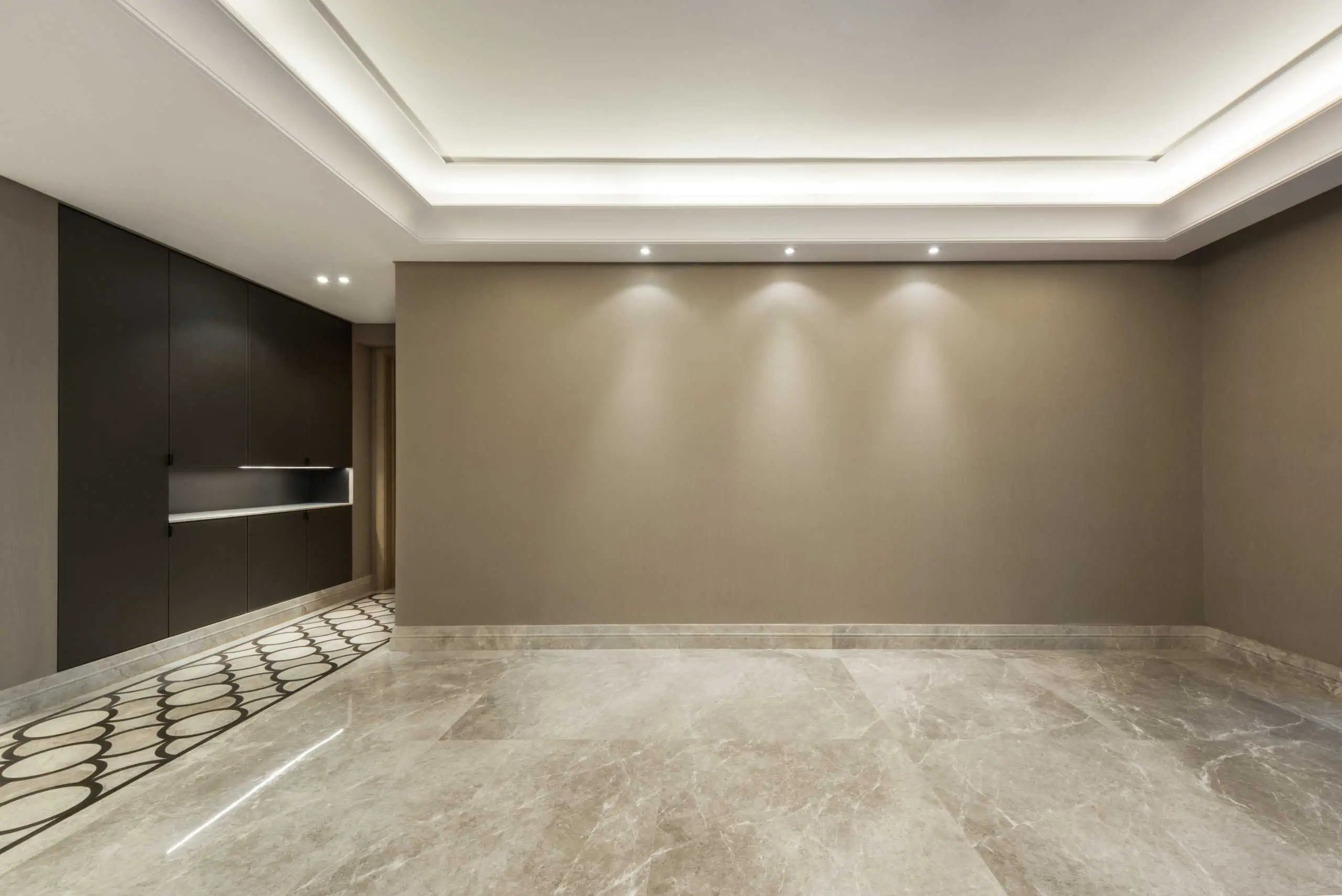
Here’s a practical framework. For high-traffic areas like building lobbies, elevator vestibules, and main corridors, professional marble tile polish is typically needed every six to twelve months. The Cooperator, which covers New York County co-op and condo building management in depth, recommends quarterly re-polishing and re-honing of surface scratches for high-traffic marble in residential buildings. That’s more frequent than most boards expect — and more frequent than most boards are currently scheduling.
For moderate-traffic areas like stairwells, secondary corridors, and laundry rooms, the interval stretches to twelve to eighteen months. Lower-traffic surfaces — think mail rooms or rarely used service corridors — can often go eighteen to twenty-four months between professional treatments.
Why does New York County specifically push those intervals shorter? Two reasons. First, foot traffic volume. A 200-unit building on the Upper West Side or Midtown East might see hundreds of lobby crossings every day. That’s not comparable to a suburban office building. Second, New York County sidewalks are heavily salted in winter, and residents track salt, sand, and grit into lobbies year-round. That abrasive material is one of the primary causes of marble surface dulling and micro-scratching — and it accelerates wear faster than most people realize.
The practical takeaway for budget purposes: if your building has a marble lobby and you’re not scheduling professional maintenance at least once a year, you’re behind. And the longer you wait, the more work the surface needs when you finally do call someone. Light maintenance on a well-kept floor costs a fraction of what it costs to restore a floor that’s been neglected for three or four years.
How to Polish Terrazzo Floors in Pre-War New York County Buildings
If your building was constructed before 1960, there’s a reasonable chance your lobby, stairwells, or corridors have terrazzo floors — and an equally reasonable chance your board isn’t entirely sure what terrazzo is or how it differs from marble when it comes to maintenance.
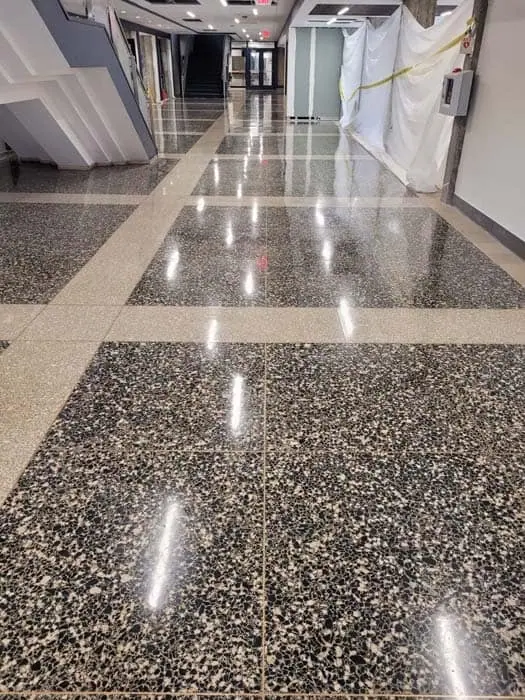
Terrazzo is a composite material: marble chips, glass, or other aggregates set in a cement or epoxy binder, then ground and polished to a smooth finish. It was the prestige flooring choice for mid-century New York County buildings and is still found throughout pre-war and post-war residential towers across the region. It’s durable, beautiful, and — when properly maintained — one of the most resilient surfaces in any building. But it’s not the same as solid marble, and treating it the same way is a common source of damage.

Terrazzo vs. Marble: Why the Difference Matters for Your Maintenance Budget
The distinction between terrazzo and marble isn’t just technical — it has real budget implications for co-op boards managing older New York County buildings.
Marble is a natural stone. It’s acid-sensitive, which means cleaning products with the wrong pH can etch the surface permanently. It scratches relatively easily under heavy foot traffic and needs to be honed and polished with progressively finer diamond abrasives to restore its surface. Sealing is recommended every six to twelve months to protect it from moisture and staining.
Terrazzo behaves differently. Because it’s a composite material with a cement or epoxy binder, it responds to different grinding and polishing sequences than solid stone. Crystallization — a chemical polishing method that works well on marble — isn’t always appropriate for terrazzo. Terrazzo also tends to develop cracks and chips at the aggregate joints over time, which require color-matched filler repairs before polishing can be completed effectively. If those repairs are skipped, the polishing job looks uneven and the cracks continue to spread.
For a co-op board managing a building with both marble and terrazzo surfaces — which describes a significant portion of pre-war New York County residential towers — this means you need a contractor who can assess and treat each surface correctly, not someone applying a single method to everything. The cost of using the wrong approach on irreplaceable original stone isn’t just aesthetic. It can cause damage that no amount of polishing will fix.
From a budget standpoint, terrazzo generally requires the same maintenance frequency as marble in comparable traffic zones. What changes is the method and, sometimes, the scope — particularly if crack or chip repairs are needed alongside the polish. A proper pre-service assessment will identify those needs upfront so there are no surprises in the final invoice.
Many boards also don’t realize that their buildings have both surfaces in different zones — marble in the lobby, terrazzo in the stairwells, for example. Getting a single contractor who can handle both in one visit is more efficient and usually more cost-effective than coordinating two separate vendors.
Restoration vs. Replacement: The Cost Argument Every Co-op Board Should Know
At some point, almost every co-op board has the same conversation: the lobby floor looks bad enough that someone suggests replacing it. It sounds like the definitive solution. It’s also, in most cases, the most expensive decision the board could make — and usually an unnecessary one.
Professional marble tile polish and restoration runs $2 to $6 per square foot, depending on the condition of the surface and the level of finish required. Replacing a marble lobby floor with comparable stone — sourcing the material, managing the demolition, dealing with the logistics of a New York County building renovation — can cost many times that per square foot, with total project costs for a mid-size lobby running well into the tens of thousands of dollars or more. And that’s before factoring in the disruption to residents, the board approval process, the alteration agreement, and the timeline.
Restoration, done on a regular schedule, eliminates the conditions that make replacement feel necessary. A floor that’s been professionally polished every twelve months doesn’t reach the point of looking irreparably damaged. The surface stays even, the shine holds, and the building’s common areas continue to reflect well on the management — which matters to shareholders, to prospective buyers, and to the building’s market position.
There’s also a sustainability argument that’s worth making to your board. Pre-war New York County buildings contain original marble and terrazzo that simply can’t be sourced or replicated at a reasonable cost today. Preserving those surfaces through professional restoration isn’t just financially smart — it’s the responsible choice for a building that’s part of the region’s architectural fabric.
The practical recommendation: get a professional assessment of your lobby and common area floors before any replacement conversation goes further. In most cases, a qualified stone restoration specialist will be able to show you exactly what restoration can achieve — and what it will cost — before you commit to anything. That assessment is typically free, and the numbers almost always make the case for restoration on their own.
Getting Marble and Terrazzo Maintenance Into Your Co-op's Annual Budget
The boards that manage their buildings’ stone surfaces best aren’t the ones with the most money — they’re the ones with a plan. A maintenance schedule, a realistic per-square-foot cost estimate, a contractor who understands occupied New York County buildings, and a line item in the operating budget that gets approved before the lobby looks bad. That’s the whole framework.
If your building has marble, terrazzo, or both in its common areas — and most pre-war New York County co-ops do — the question isn’t whether professional maintenance is worth it. It’s whether you’d rather budget for it now or pay significantly more to deal with it later.
We work with co-op boards and property managers throughout New York County, handling everything from lobby floor restoration to ongoing maintenance programs for multi-story residential buildings. If you’re ready to put a real plan together, reach out for a free estimate and we’ll start with an honest assessment of what your surfaces actually need.